Nicholas Fluhart

October 15, 2009

Industrial Actuators – Part 1

Filed under: Industrial Actuators — Nicholas Fluhart @ 10:05 pm

My company OmniSales International recently expanded our diversified offerings into industrial service work. Specifically, we are now offering a rebuild service for industrial actuators.

What is an actuator? A basic definition can be seen here. The applications for which our actuators are typically used is on industrial valves. The actuators provide a way for operators and/or computers to open and close valves remotely. The two most widely used types of actuators are electric and pneumatic. The type we service is pneumatic. Of those, we service vane type, rack and pinion type, and linear type.

One of the vein types we service is the Xomox Matryx series.

Xomox MX200's just unloaded for rebuild.

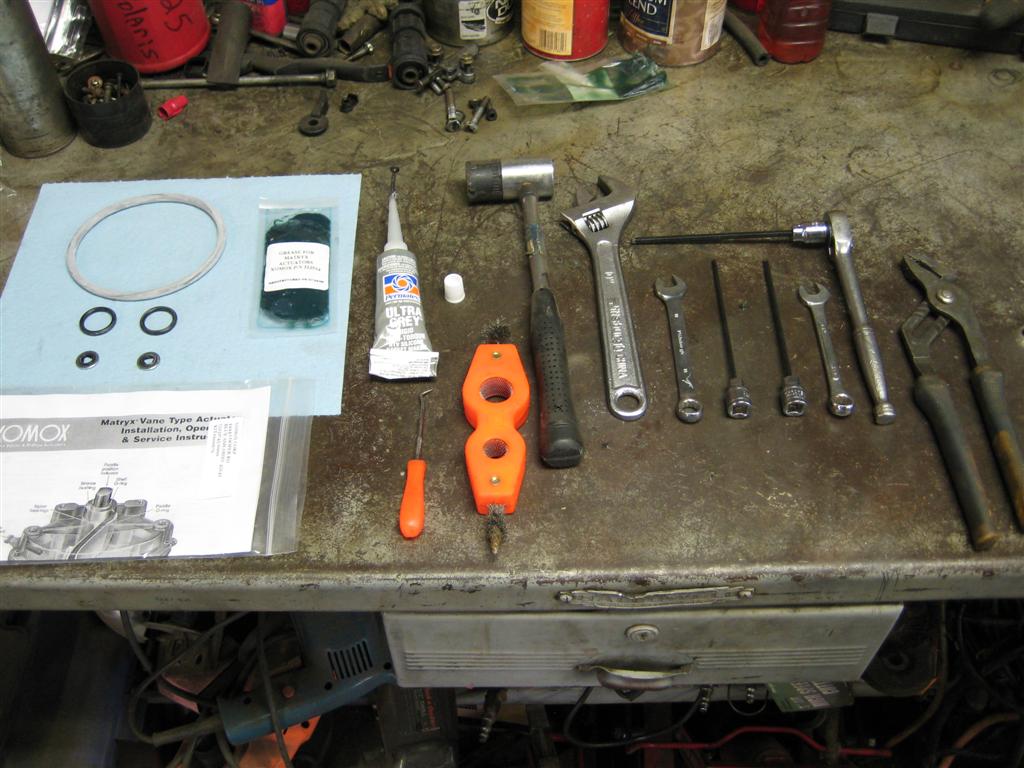
Parts and Tools laid out for the project.

I begin by cleaning the external surfaces of the unit in my parts washer. I then place the actuator in my vise which has specially designed jaws which are useful for gripping odd shaped items. Once secure, I remove the case bolts and fix a puller onto the actuator and use it to evenly separate the case halves.

My Bench Vise
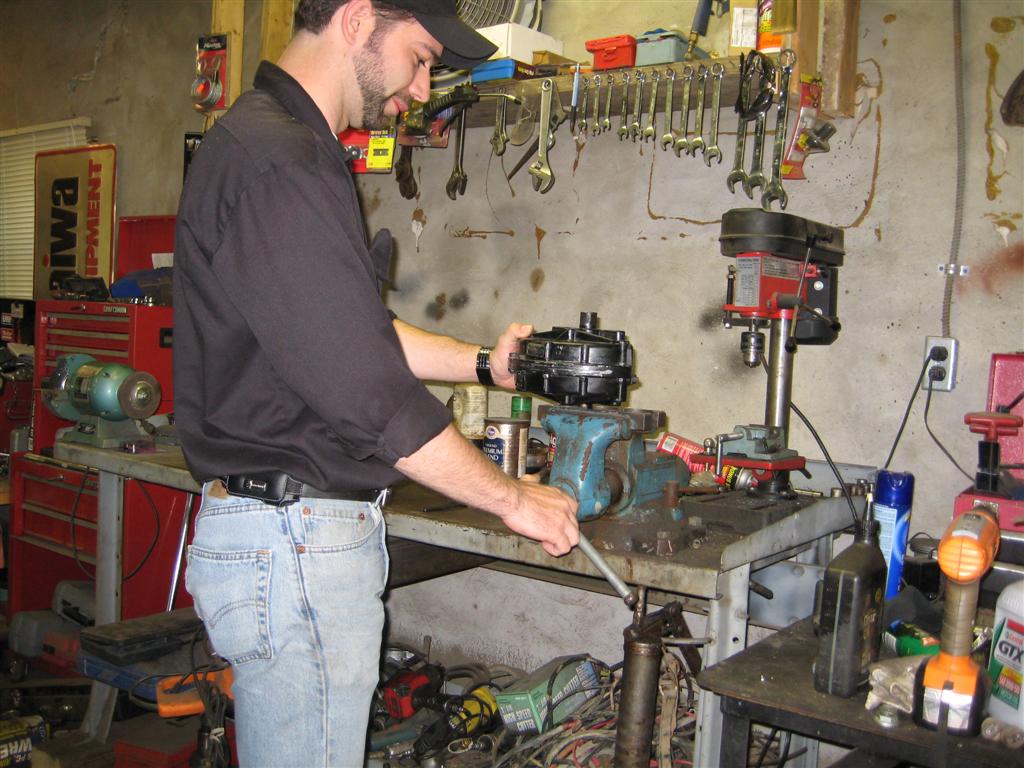
Placing the actuator in the vise.

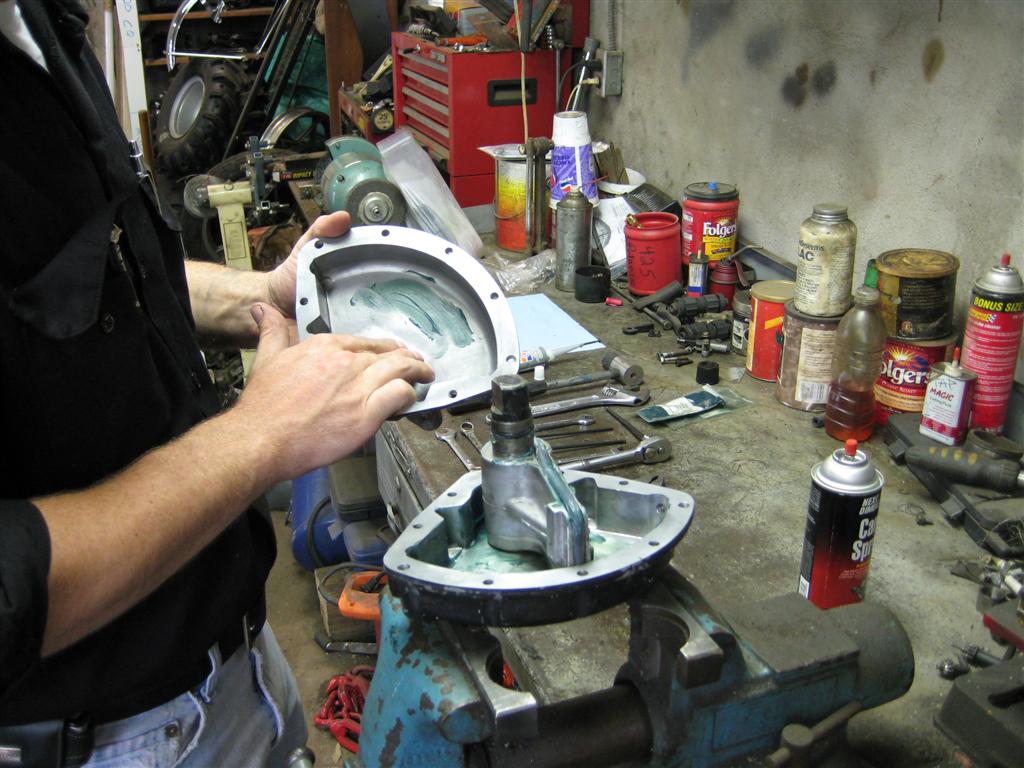
Splitting the cases.

Once I split the cases and disassemble the unit, the soft parts (i.e. o-rings, seals, etc.) are removed and the components go back to the parts washer to be cleaned of any dirt or grease.

Disassembling the Components

The Inside

Once cleaned, the rebuild process can begin. Typically, the components replaced during the process are known as “soft parts” which consists of o-rings, seals, guide bands, and in some circumstances bushings and bearings. For most used actuators, if hard parts, such as veins, pistons, cases, etc. need to be replaced, the actuators are usually scrapped as the cost of the new parts exceeds the value of the used unit. For this reason, I try to keep a supply of these scrapped actuators on hand for parts. That way, I can offer the customer a used part for a fraction of the cost of a new one.

Cleaned and ready for final inspection.

When the parts are clean I can closely examine them for wear or damage. Once inspected, I use a fine, high speed, concave style wire wheel to polish the inside of the cases where the main o-ring wiper seal rides forming the air-tight seal between the cases and the vein. I then apply the grease supplied by the manufacturer to all the components and install the new o-rings and seals.

Polishing the seal surfaces.

Assembly

I apply sealant to the case joints and assemble the body, replacing any nuts or bolts that show wear. I coat the actuator in a corrosion resistant, high temp enamel coating. Once the sealant and coating have set up, it’s time to test the unit and set the adjustable stop screws. I plumb an air pressure regulator to the unit and begin leak testing.

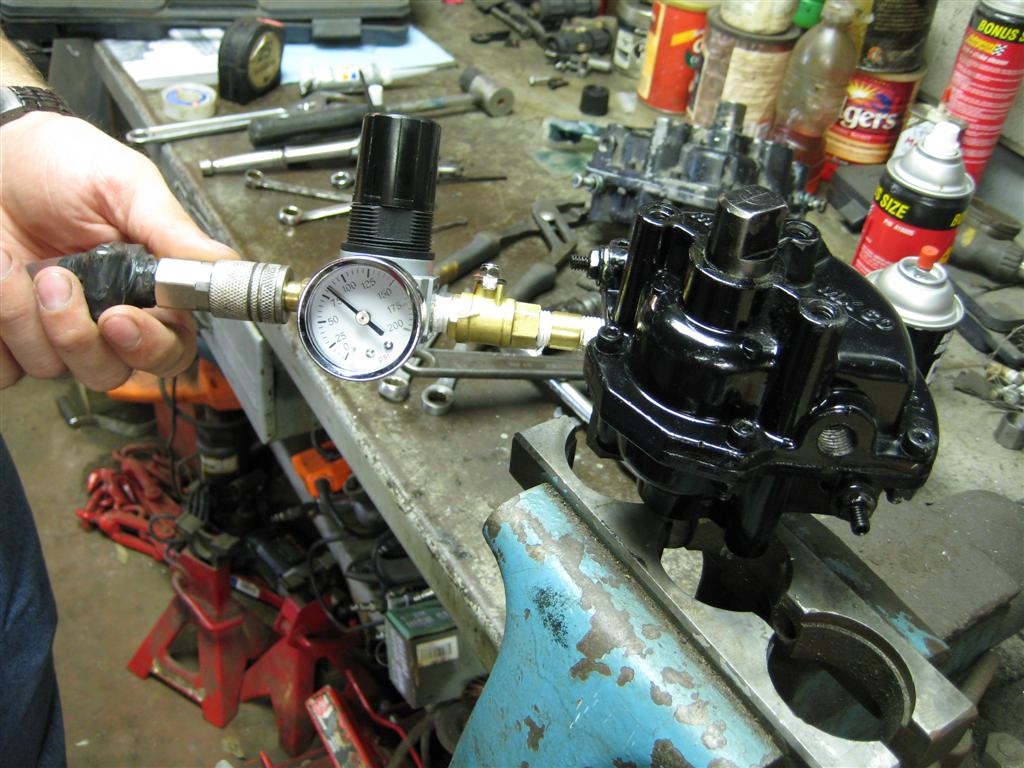
Testing an MX200

Testing an MX60

The max air pressure for the Matryx MX series is 120 psi. I run the pressure up to 120 on the dot and spray the joints with soapy water to look for leaks. When everything checks out, I stroke the actuator starting at about 25 psi and continue to do so up through 80 psi which is the normal operating pressure. I ensure the actuator strokes easily in both directions with no internal leak through. If there is any binding or catching, it will be very evident at low pressure which is where the actuator would have the least torque. Typically, if the actuator strokes easily at 25 psi, it will perform well at any higher pressure.  When it passes my tests, I unhook my testing apparatus and install cap plugs in the air ports.

Ready to ship!

Off they go!

Off they go!

October 4, 2009

Project: CR250

Filed under: Project: Honda CR250 — Nicholas Fluhart @ 1:14 pm

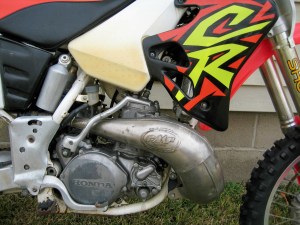
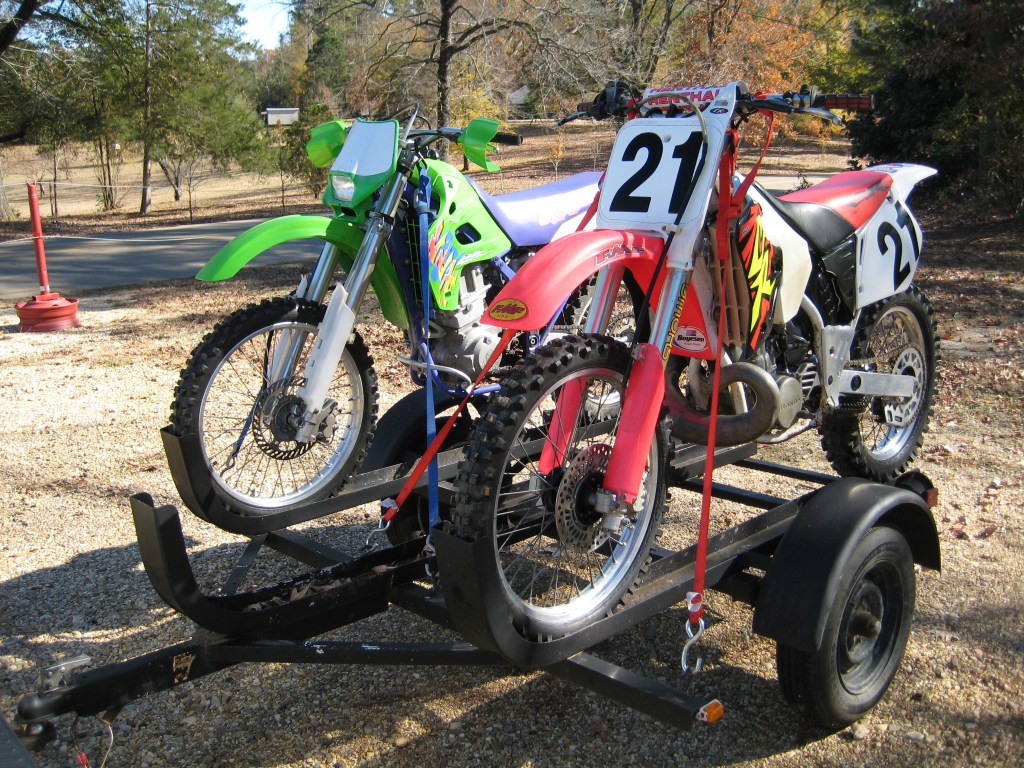
In early 2004 I purchased this 1993 Honda CR250 with the intention of riding it for a while, having some fun with it, and then selling it for a small profit, a process I try to do frequently. Of course now I have much less time available for the riding and fun portion of the process, but that’s a different story. Moving on…

The 1993 model is often called the “Jeremy McGrath Special” as it was the bike he used to captivate motocross fans around the world while winning titles willy-nilly on a level few before him had ever done. This model is considered the “Ginsu Knife” of CR chassis because of the superb frame geometry that promotes precision handling and control superior to models prior to and many years after.

1993 Honda CR250

I bought this one for $950. Although it was in excellent condition, loaded with performance parts, I usually don’t give that much for older machines that I purchase for resale, but until that time I hadn’t owned many dirt bikes. I had always wanted an ultra-fast motocross bike like this one and I had some extra cash, so why not? It was a good deal. At the time, clean ones like this were bringing between $1500 and $1800 on eBay.

– New Dunlop Motocross Tires
– New Renthal Chain and Sprockets
– FMF Gold Series Header
– Pro Circuit Carbon Fiber Silencer
– Boyesen Power Reeds
– Renthal Handle Bars
– Graphics Kit
– Ported Cylinder
– Wiseco Piston

A very clean bike for it’s age.

I took the bike on a good long ride and had a blast. However, I noticed the gas tank had a small crack in the neck that leaked when the gas would slosh around, and also, the needle valve in the carburetor wasn’t seating properly causing fuel to leak from the overflow line. I tried applying sealant to the tank, but it didn’t work. I tried to clean the needle seat in the carburetor (the seat is non-replaceable) and replaced the needle, but that didn’t work either. So I got on eBay and found a tank for about $35 and a carburetor for $50. Then I was back in business. I took it on one more good ride with my total investment at about $1035. It was around this time that I noticed cold starts becoming very difficult. This was due to low compression. I decided to park the bike until I could do a quick ring job. I didn’t want to continue to run it with worn rings because that would allow the piston to slap the cylinder walls and do further damage.

Four Years Later…

Well, I finally got around to fixing the CR. I had planned to do it sooner so I could sell it while the value was still in my profit margin, but other projects got in the way. Fortunately the value on these seems to have bottomed out at around $1200 to $1500 which keeps me in good standing.

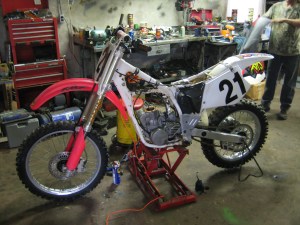
I disassembled the engine to see what I was in for.

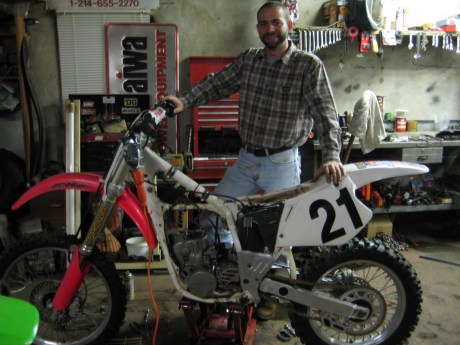
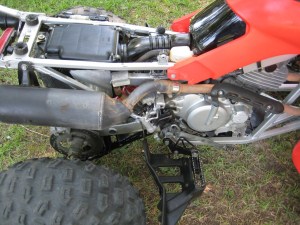
CR250 in the Shop

Finally Getting Started

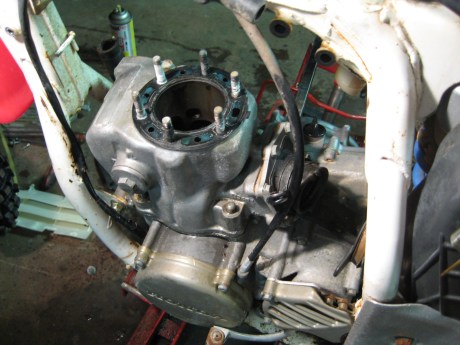
Removing the Cylinder

Ready to Remove the Cylinder

Overall, good news. I pulled the cylinder to find exactly what I had expected and planned for, worn rings. The piston itself was in good shape, with minimal skirt wear. The cylinder was great, no grooves or excessive wear. These are nicom plated aluminum cylinders, so they can’t be bored or repaired without sending it off to be replated. I was able to run a light, fine hone through this one and it was ready to go. I ordered a set of rings from bikebandit.com.

When my parts came in I went back together with it.

Reassembly

Just Installed the Cylinder

Finishing Up

Finishing Up

When I got it all back together, I saddled the bike and it started on the very first kick. After setting for four years, it fired right up and ran like a top. I cleaned and polished it from front to back and listed it for sale. My entire investment was less than $1100. I could have quickly sold it for $1200 but I decided to hold out for a little more in an attempt to make the whole thing a little more worth it. I knew when the right buyer came along I could get at least $1300, and that’s just what I did. It took a few months but I finally sold it for $1300 leaving me with a fun experience and $225 in net profit. Not a big dollar amount, but at least I made something and I enjoyed the experience. Can’t ask for much more!

KLX650 & CR250

My CR250 & My KLX650 Good Times!!!

September 27, 2009

Followup on the Forklift Hydraulic Repairs

Filed under: Project: AC Forklift,Trucks & Equipment — Nicholas Fluhart @ 10:02 pm

This is a followup on the short lift cylinder repair. To see the later hydraulic repairs, click here.

Overall, the hydraulic repairs on the forklift were a success. The cylinders that we overhauled aren’t leaking a drop. The only notable issue we now have is with the lift cylinder we installed the new packing in. Often times when new packing is installed the cylinder is a little more stiff in operation until the seals and such seat in. This may be magnified slightly by the seal modifications made by the hydraulic shop (see the original post). With a double acting cylinder, this is rarely even noticed. However, with a single acting cylinder like the one I am dealing with, it can complicate operation.

The Issue: The cylinder powers up fine, but until the packing wears in it has made the cylinder a little too stiff for gravity to pull the forks back down. So when I pull the lever to lower the forks, they don’t move. Typically, what goes up must come down. Not so anymore; it’s a one-way street. The only way to get them back down is to apply a load of at least 300 lbs.

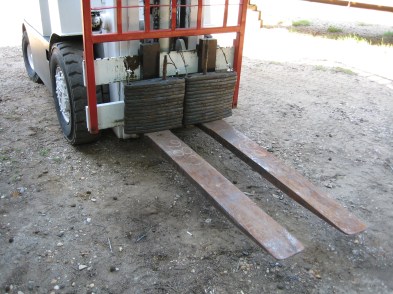
Solution: The more I use the forklift, the better it gets. However, since I only use it occasionally, it may be a substantial amount of time until the cylinder wears in. Until then, I’ve developed a short term solution. First, I added fork extenders. This is a two-fold benefit: it gives me additional fork reach, and it adds about 150 lbs to the forks which helps my cylinder issue. Second, I added about 330 lbs of low-profile weights to the forks.

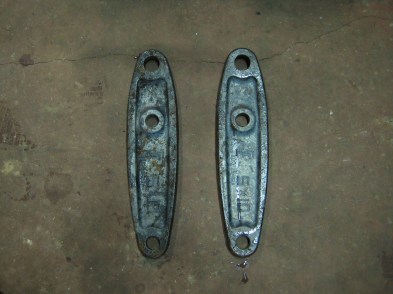
These are actually some type of linkage component, but they weigh 11 lbs each and they are slightly raised on one end making them stack together perfectly. I purchased about 75 of these for less than a buck a piece at an auction with this specific purpose in mind.

Weights

I calculated that I could stack about 15 of these on each fork and place them directly at the base. I placed an axle through each stack with a close diameter to the holes in the weights. This holds them stacked and in alignment even when they get bounced around. I then used winch cable to tie each stack in place.

Fork Weights

Success. So far, it’s proven to be a good solution to the short term lift cylinder issue. I’ve used it to load a variety of types of materials ranging from crates to scrap iron and the cylinder operates better and better all the time. The low profile weights keep them out of the way and the extended forks more than make up for the used space. I can comfortably leave the weights on the machine indefinitely until the cylinder wears in properly.

September 23, 2009

Another TCB Post

Filed under: Day to Day — Nicholas Fluhart @ 10:40 pm

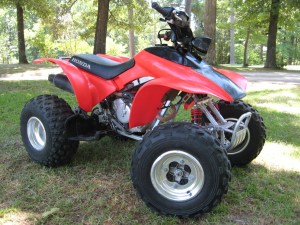
Just thought I’d put up a quick post showing one of the many things I do at my company, OmniSales International. Part of the daily ‘taking care of business’ (TCB). One of my customers contacted me about a clean Honda 300EX ATV he had purchased for resale. Knowing that I deal on the internet, he knew that I could make him a quick sale for a nominal fee. So how do I go about doing just that?

First I immediately begin conducting research to see what similar ATV’s have sold for over the last 30 days and the location of the sales. This gives me an idea of the current market and the specific regions where our potential buyers will be located. It also gives me an idea of the price for which we will be able to sell the ATV which tells me whether or not my service is the best alternative for the customer. In other words, it tells me if the ATV will sell for enough money to get my customer the amount he needs after my commission is deducted.

I then choose the sites I will use, i.e. eBay, Craigslist, online classifieds, etc. and I develop the representation of the item with a competent, informative description and exceptional photos. In this particular case, I used eBay and this is how I setup the listing. I use a variety of full bike shots and closeups at different angles and sequences depending on what I’m trying to accomplish.

A small example of some lower quality pics, but you get the point:

EX-1 EX-2
EX-3 EX-4
EX-5 EX-6

Then I top off the fantastic description and photos with a video to best show the item’s condition, meaning I show the ATV starting, idling, operating, etc. It’s important to realize that when a buyer is buying something from a remote location, sight unseen, the video really makes the sale. They get to not only hear the machine run, but also see it operate.

Here’s the clip I used:

And that’s pretty much how it goes. I sold this one quickly and my customer and the buyer were both happy.

Until next time…

September 21, 2009

Hydraulic Repairs

Filed under: Project: AC Forklift,Trucks & Equipment — Nicholas Fluhart @ 7:45 pm

Time for some repairs! Since I’ve owned this forklift it’s had minor leaks in the primary lift cylinder and one of the tilt cylinders. The secondary lift cylinder and the other tilt cylinder were still in good shape. Eventually, the lift cylinder leak developed into a steady drip leaving puddles wherever it was operated and one day the tilt cylinder oil seal blew out altogether. It was time to address the issue.

I had my company mechanic helping me on this job; it’s nice to have a hand on the heavier stuff. Many people are afraid to work on hydraulics, but cylinder repair is actually fairly easy. In fact, most of it is easier than working on motorcycle forks.

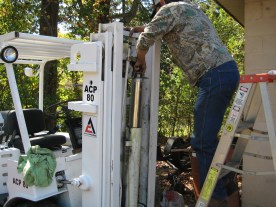
I started with the lift cylinder. Given its size, it was easier to disassemble on the machine. We unhooked the lift chains and lines accordingly. We then used a chain wrench to remove the gland nut.

Removing the Gland Nut

Removing the Gland Nut

Once the gland nut was removed we were able to begin pulling the ram tube.

Removing the Ram

Removing the Ram

Inspecting the Bore

Inspecting the Bore

Once everything is loose, the ram pulls right out and you are ready to install your new packing components. The wiper seal is typically located in the gland nut and the guide bands are usually on the ram.

For the tilt cylinder, we simply removed the whole unit and disassembled it on the bench. It comes apart the same way as the lift cylinder. Once we had the parts pulled we were able to measure for replacement packing.

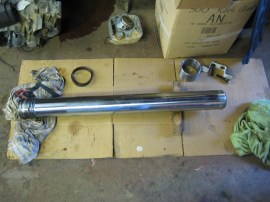
Removed Laid Out

The lift cylinders are single acting. They power up and load gravity pulls them down. The tilt cylinders are double acting, they power in either direction.

Rather than search for parts online, which is what I usually do and probably what I should have done here, I figured it would be faster to go to the local hydraulic shop although they are typically very expensive. It turns out, the seal used on the lift cylinder was obsolete (or so they told me) and hard to order, so the shop fitted the gland nut with a more common seal diameter by using a lathe to turn the inside of the nut to a larger diameter. The other components were easy to order but unfortunately, the entire process took them about two or three weeks because they apparently had systematic memory failure which inhibited them from placing the order for the seals in a timely fashion. The cost of the parts and labor from the local hydraulic shop (not including hydraulic fluid and the labor on my end) was $198.00. Once I got all my components we had the machine back together within a couple of hours and it was ready to go. I think next time I’ll find the parts myself…cheaper and faster.

Click Here for an UPDATE.

Click Here for more hydraulic repairs.

« Previous PageNext Page »

Blog at WordPress.com.