I recently experimented with a tire change on my Omni Recovery Foreman. As previously discussed in my first Tire Change Post, I’ve been running a set of 26″ Dirt Devil XT’s which are no longer in production. They are essentially the most aggressive of the Dirt Devil family. Overall, I’ve been happy with the Dirt Devils, but there are a couple of areas I’d like to improve in. One, is performance in wet sand such as that found in creek bottoms and on banks. In many cases I have to climb steep, wet creek banks, but I don’t want to compromise too much in mud traction, so finding a balance is difficult. Second, is overall driveablity. My Dirt Devil combo, although superb in mud, is a heavy and rougher riding set. I’d like to try something a little more nimble and smoother riding. I recently got an opportunity to try something different…
I purchased a Foreman to part out, and it happened to have a nice set of 27″ SwampLites on ITP steel wheels. I had to give them a shot on my machine. The rims they were on had gotten a bit rusty, so the first thing I did was strip them down and paint them low-gloss black. Then I installed them on my Foreman. You can see the difference one inch in tire diameter can make as seen below:
SwampLite on the left, Dirt Devil on the right.
The SwampLite on the left is taller, and the Dirt Devil on the right is wider. I’ll discuss the pros and cons at the end of the post. Here is what the finished product looks like:
Conclusion:
Shortly after installing the new tire combo, I took it on a good night ride and developed some conclusions. In comparison to the Dirt Devils, I found that the SwampLites certainly rode smoother overall, and the larger diameter gave my Foreman a better top cruising speed. Also, I was surprised at how much the additional ground clearance helped. In wet sandy conditions, the improvement was moderate but not as much as I had anticipated. And for the cons… I immediately noticed that the SwampLites didn’t get near the traction on most surfaces that the Dirt Devil XT did. This is due to a combination of the less aggressive tread (in soft terrain) and the more narrow footprint (in all terrain) of the SwampLite. I wouldn’t mind that too much if the combo was lighter than my Dirt Devil setup, but when I compared them, they were both about the same weight so I really didn’t gain anything there. And finally, I learned that 27″ tires, a bit taller than the 26″ (and certainly taller than the stock 25″), proved to be a bit much for the stock suspension geometry. The front tires rubbed the fenders when the suspension flexed heavily, and I could feel some pops and tweaks in the chassis that I didn’t normally notice. My synopsis: I believe the SwampLite is a decent all-around tire, but if I were to run a set, I would downsize to a 26″ and place a wider size on the rear for better traction. I actually think they would be a good combo for my machine. But at the end of the day, the 26″ Dirt Devil XT is a better fit for my machine and riding style than a 27″ of any brand. So that’s what I’ll stick with for now. If I can find a deal on something a little less aggressive but keep the current size, I think we’ll have a winner.
Oh, and I’m still keeping an eye out for a set of factory style aluminum rims…
I had a fun outing to my land lease shortly before hunting season. My brother and I were riding our ATVs when we came to a section of the road that flooded a couple of years ago due to beavers damming up a nearby creek. We weren’t far from our destination. To turn back would mean adding another hour and a lot of additional miles to the ride, and it was a hot, dusty day; I really wanted to get into the water. There was a lot of seaweed and lily pads making it impossible to see the bottom and judge the depth. My main concern was a possible under-water trench from a culvert that had washed from under the road and was now floating at the shoulder. There is a swamp to the right of the road and a deep creek with moving water to the left, and water from the creek is now moving across the road into the swamp. Since I cannot see the bottom I could easily drive into a trench, drop out of sight, and loose my quad.
At this point most people would turn back….but I’m not most people. I love a challenge, especially when there’s a little danger involved. I had a plan. I began looking around for a tool that I could use to give me an edge, and then I found it: an old tree branch. I eagerly snatched it up to carry with me across the abyss. I would use the precision instrument to gauge the depth of the water in front of me as I drove along.
Selecting my precision instrument.
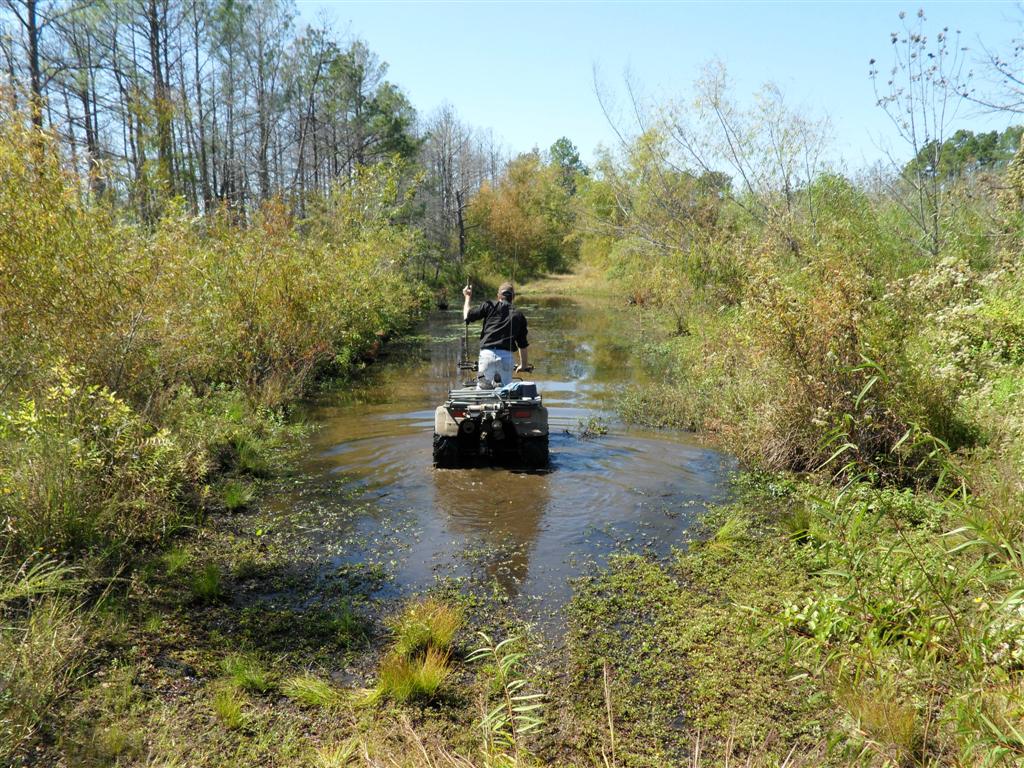
And then it begins. I inch my way out into the water. I look ahead to the other side to guesstimate where I need to be in order to keep myself centered on the road. It’s a little more difficult than it looks. As you can see, I don’t have my rubber boots on (at that time it hadn’t rained in two months so I wasn’t expecting mud or water) so I climbed onto the seat of my ATV.
Putting In
It’s relatively easy at first, but then the water starts to get deeper. However, it’s not so much the current depth of the water that gets my blood pumping, it’s the unknown variables. I absolutely cannot see through the murky water. How deep is it in front of me? Where are the shoulders of this narrow old road? If I get too close to the edge, which I cannot see, I could slide off the road into chest-deep water. There’s nothing I enjoy more than this type of riding!
Further into the unknown.
The water is getting deeper, naturally, but I could still turn back before this outing turns into a travesty. ….Not a chance. At this point I’m hooked; the only way I’d go back is via winch-line. I keep moving…
A little seaweed.
Past the point of no return now. As my depth gauge encounters an indigenous life form, I feel some obstacles on the ground beneath me. Probably a log? An old pipe? Who knows what’s down there considering I’m riding in a WWII era munitions depot. I try to correct…
At the edge.
…aarrrgg! Too much! I almost slid off the shoulder of the road. It’s narrow and impossible to see. I slow to a crawl as I use my stick with the value of a life preserver.
The half-way point.
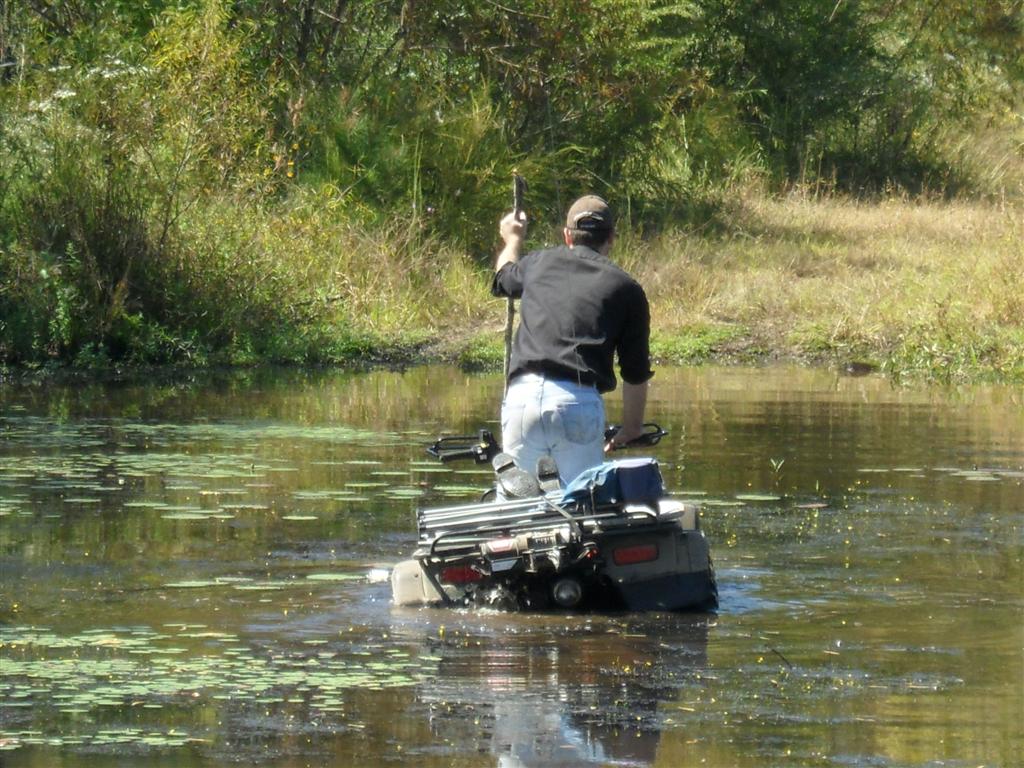
As I reach the half-way point I’m encouraged to continue, however, the deepest section is yet to come. As I pass a flower on a lily pad I notice there is a slight current and I’m approaching the area where I believe the culvert was. With nerves of steel, I press on.
Approaching the deepest part.
With my exhaust pipe soundly under the surface gargling creek water, I realize I’m right in the deepest section where the culvert was. Fortunately there was not a deep trench there, but there was a bit of a dip. I pushed through and the front of the ATV bobbed as the water rolled up on top of the front fenders.
In the deepest section.
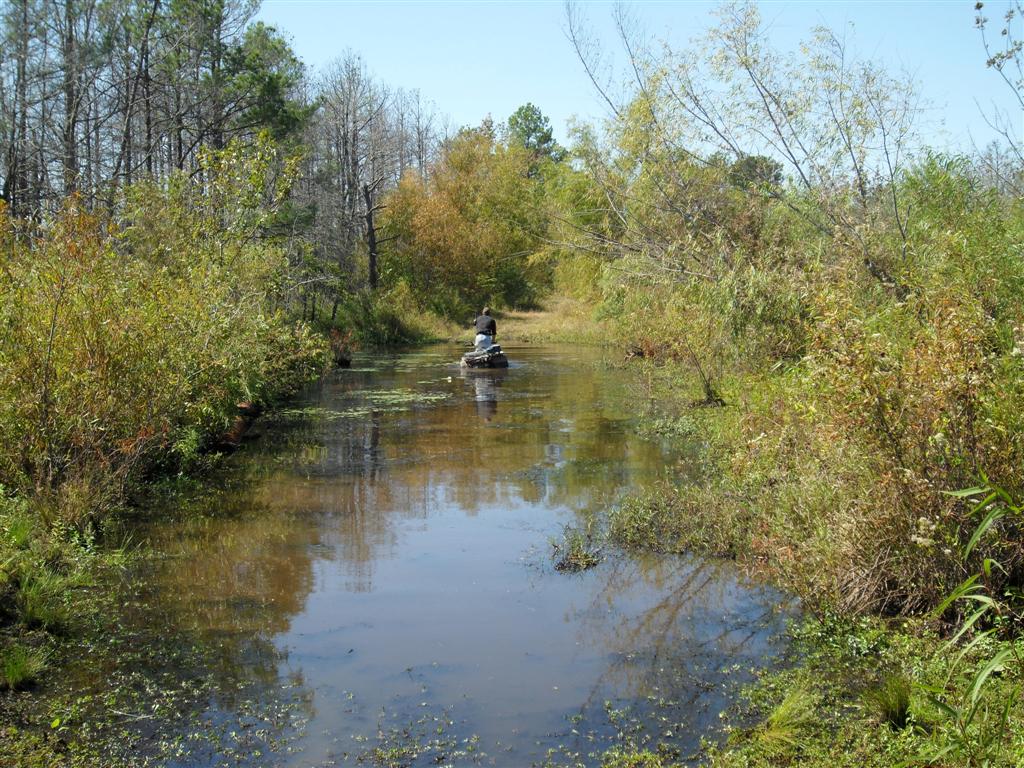
As I traverse through the dip I see light at the end of the tunnel and I know I can make it. At this point in a challenge I tend to get a little excited so I picked up the pace a bit. Before I realize it, the water is getting shallow and I near the bank. Alright! I did it.
I completed an interesting project a while back. It is a 1989 Yamaha 350 Moto-4. I love old machines! These bikes were the predecessor to the 2WD version of the Big Bear. This was a very heavy-duty machine, and as such there were some very interesting industrial variations of it that were groundbreaking in the industry. One of these was the Terrapro which had, to my knowledge, the only Power Take Off (PTO) available on a four wheeler. It had a variety of very functional attachments available from Yamaha, such as a rough cut mower, finish mower, tiller, etc. The other innovative spin-off was the Pro Hauler, which utilized what is considered the first ATV cargo bed. In contrast, the 350 Moto-4, while industrial at heart with it’s Hi/Lo 10-Speed transmission, is more of a general purpose utility ATV.
I stumbled into it almost unintentionally. I purchased a group of ATV’s in south east Arkansas and this one was in the lot. I essentially got it for free. It looked fairly junky and I didn’t have any specific interest in it at the time, so it was unloaded and hauled around back where it stayed for a few months. Here’s a video clip of me unloading it at my shop:
When I bought this quad, I never intended to do anything but scrap it. My initial thought was to either sell a few easy parts, such as the carb, CDI, etc., and scrap the rest, or perhaps sell it whole as-is for parts or a project bike. However, upon closer inspection, I noticed a few things that grabbed my attention: The bike still had the factory original tires on it, which were in good shape. All the wheel bearings and seals were in good condition. Although the cosmetic condition was very weathered, the bike was remarkably untouched and noticeably sound overall.
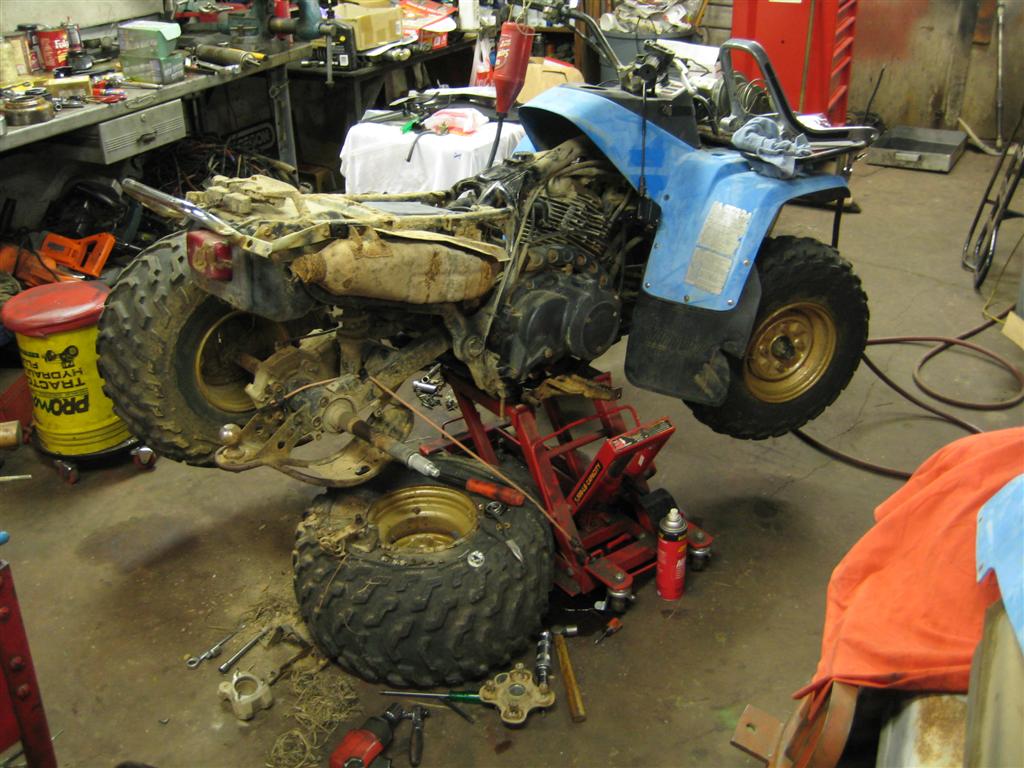
So what does all this mean? It means that the bike probably didn’t have any real hours on it, and thus the mechanical condition was likely in decent shape requiring only minor restoration. My theory was that the bike was adult owned and ridden for most of its life and perhaps was later passed down to a kid who promptly broke it and left it out in the weather for a couple of years. With this in mind, I decided to see what it might take to get it running. If it could be repaired easily, I could fix it up and it would be worth around $1200 to $1500. So I pulled it up in the shop…
As I looked it over, I made a few notes. The one thing I knew it needed immediately was a carburetor and a hot battery. I already knew the chassis was in good shape, so if the engine ran good, all it would need was a quick cosmetic restoration. The good thing about being in the parts business is that I usually have a few spare parts laying around. While I didn’t have a carburetor for a 350 Moto-4, I did have one for a 350 Warrior so I decided to make it work. I cleaned it thoroughly and found an intake boot. I then installed the assembly using the Warrior throttle cable (P.S. The aftermarket intake boot is ridiculously fragile. They split easily. I went through two of them on this project).
Warrior Carb on the Moto-4 Intake Boot
Installed
Well, good news and bad news. The good news is that the engine ran. The bad news is that it was a total travesty. The jets in the Warrior carb were too rich for a stock setup, so it ran poorly and smoked. Also, the cam chain in the engine was rattling and the starter clutch was going out. Decision time: Do I scrap the project or order some parts? For me to make any money on this thing, I need my total investment to be $500 or less. So I needed to guesstimate my total parts bill if I fixed this thing from one end to the other in order to sell it for a good price. It’s always a bit of a gamble, but I ran some loose numbers and given my access to used parts and my discounts on new parts, my figures indicated I should be OK. Theoretically.
So I went for it. I ordered a carburetor kit for around $20 and a D.I.D. cam chain for $25. For the starter clutch, I went used. I got on eBay and won an auction for a Warrior flywheel, starter clutch, stator assembly, and stator case, all for $55 (the Warrior and Moto-4 starter clutches are interchangeable). I only needed the starter clutch, so I kept that and resold the bare flywheel for $35, and the stator w/case for $85. So that puts my total parts bill thus far at -$20. I’ve already made 20 bucks and I haven’t even done anything! I love eBay! Moving on…
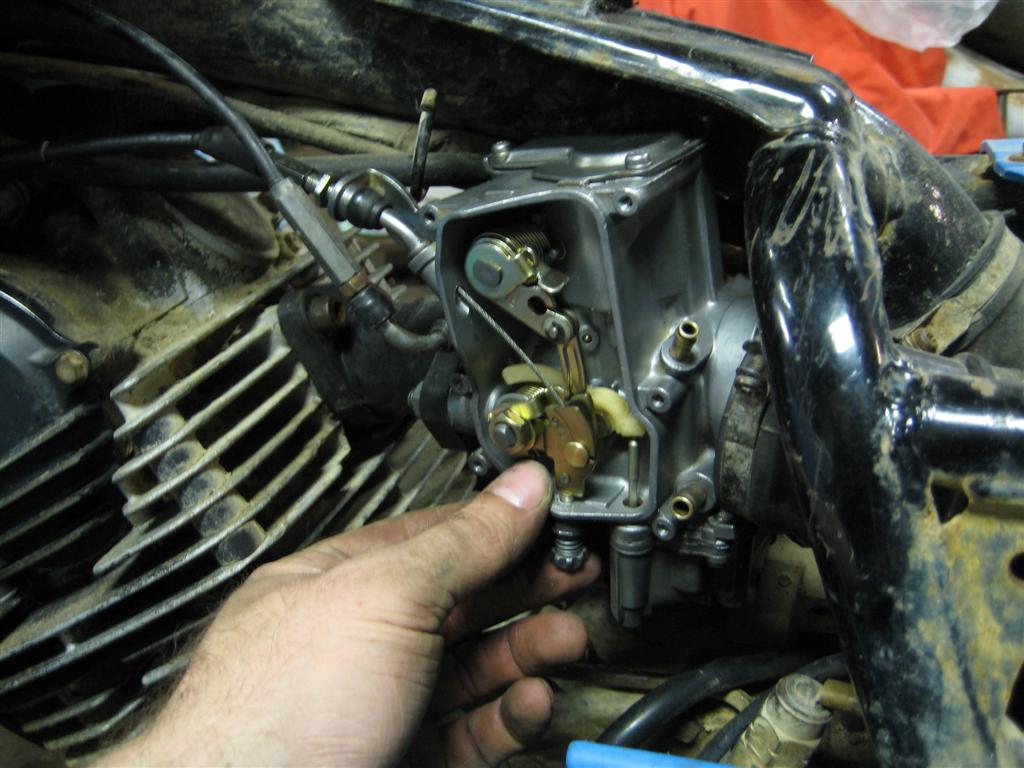
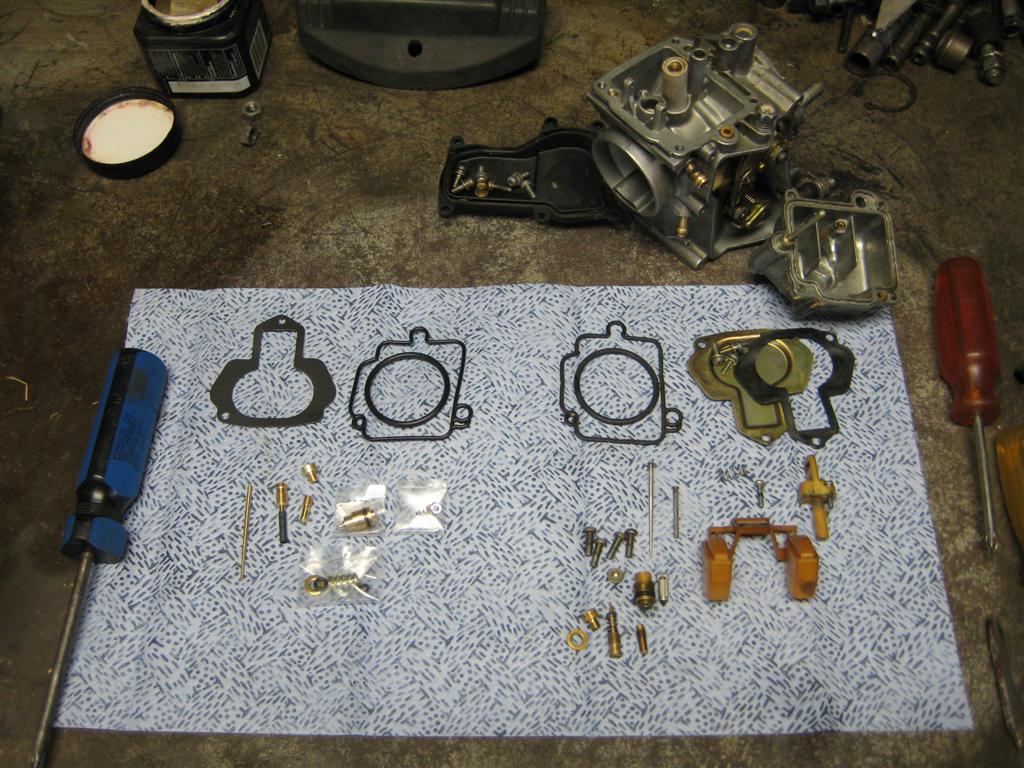
So I pulled the carb back out and installed the kit:
Using the stock jets seemed to fix my rich burn problem. The engine ran pretty good, albeit noisily. I jumped on it to test drive it and check the clutch and transmission. It actually drove pretty good and had a lot of power, but unfortunately it revealed a few other problems. The engine smoke didn’t clear up and the centrifugal clutch wouldn’t disengage. This project, like most, was rapidly snowballing.
Oh well…in for a penny, in for a pound. I decided to disassemble the engine and assess the damage. If my hunch was right, all it would need is a set of rings, and since I already had to partially disassemble the engine to replace the cam chain and starter clutch, it would only take a few more steps to install a set of piston rings.
First I addressed the centrifugal clutch issue. It turns out that the shoe springs had fallen off somehow and were digested by the transmission. Hmm….I’ve never quite seen that happen before, but there’s a first time for everything. After ordering and receiving the wrong springs twice, I decided to replace the entire centrifugal clutch assembly with one I had on the shelf which was out of a 1995 Kodiak 400. Success!
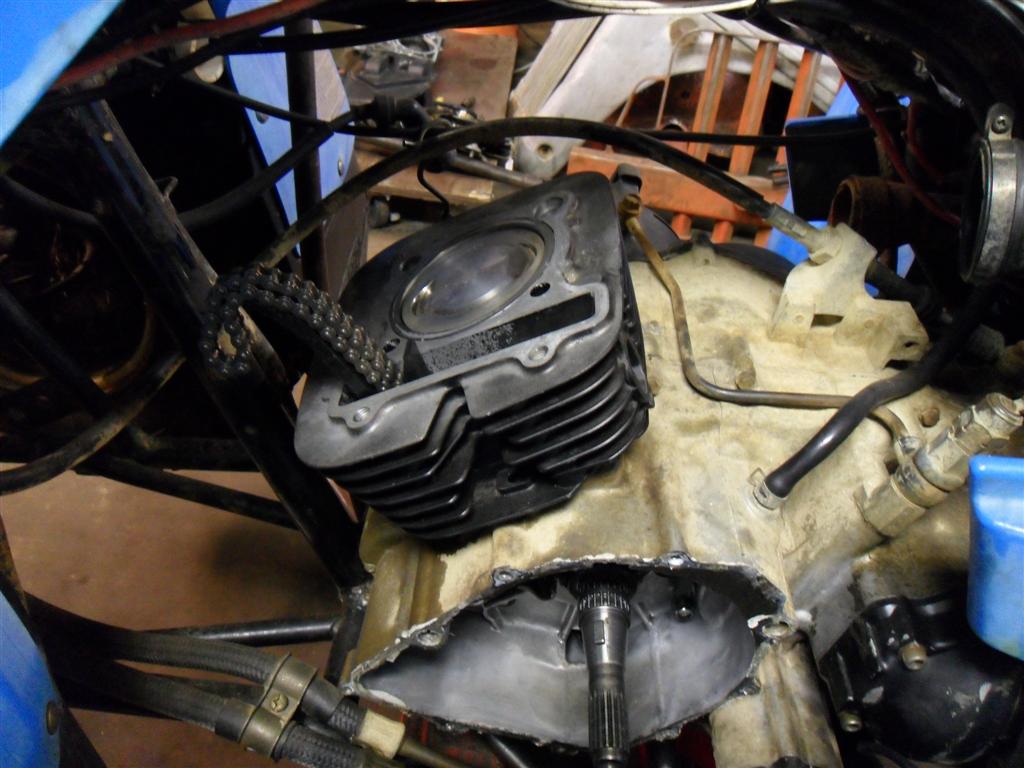
Then I began the main teardown. I removed the head, cylinder, and then the stator and case and of course the flywheel/starter clutch assembly (this requires a special tool) and I was then able to remove the cam chain.
Cylinder Head Removed
Cylinder Removed
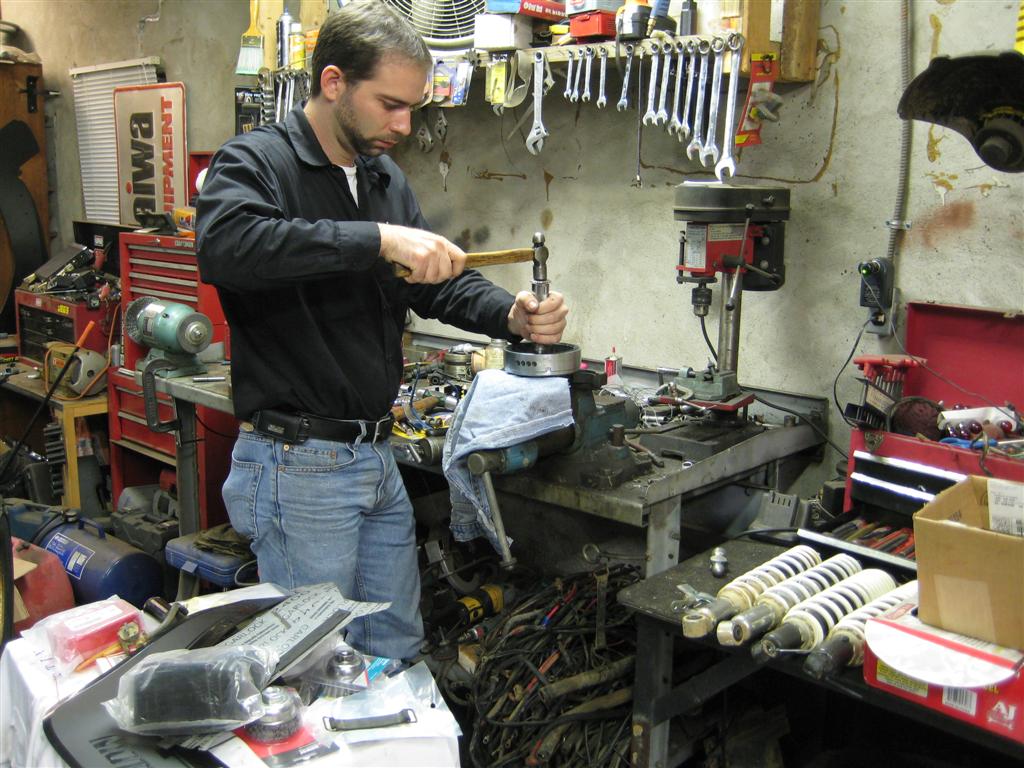
Once removed, I saw that the piston rings were worn. I made note of the size and ordered a set for around $20. The cylinder was in decent shape for the most part, but there was a slight ring ridge at the top. Rather than risk breaking my new rings, I used a Zimmerman Ridge Reamer to remove the ring ridge. Some of you old-timers may know what that tool is. It’s a cutting tool invented by Herman W. Zimmerman in 1935 that’s designed to cut ring ridges much like a boring bar would. It worked perfectly. I then honed the cylinder and installed the new rings.
Reaming the Ring Ridge
Cylinder Installed
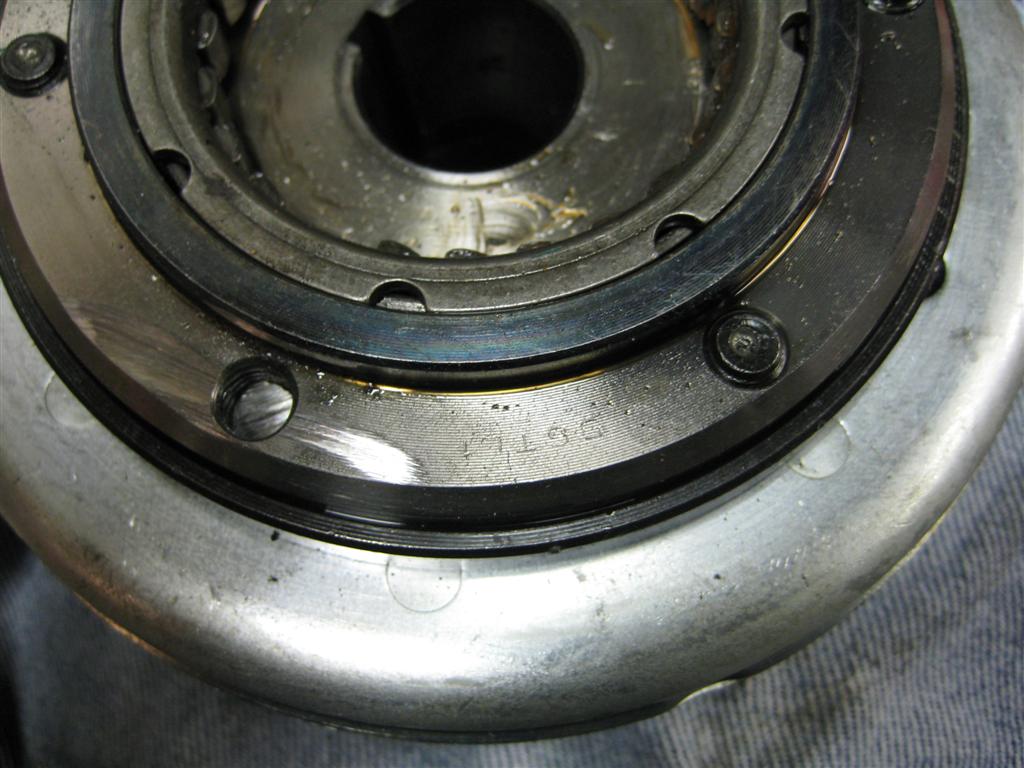
To install the new starter clutch sprag, I first had to remove it from the Warrior flywheel and install it on the Moto-4 flywheel. While many would mistakenly believe the two flywheels are interchangeable, they are not. If you look closely you will see the ignition pickup surface is longer on the Moto-4 and is located in a different position.
It is very difficult to get the bolts out of these because when the factory installed them, they took a punch and smacked the end of the bolt after it had threaded through. This was to swell the threads and prevent the bolt from becoming loose. Since they are Allen bolts, you can’t get much torque on them without rounding them off. So what do you do?
I took my angle grinder and gently ground off the swelled end portion of each punched bolt. I ground it down smooth with the surface as seen below.
Using the Grinder
Bolt end ground smooth.
I was then able to take my impact driver and remove the bolts manually.
Removing the bolts with an impact driver.
Once ground smooth, the bolt turns easily.
Then it was time to install everything. It worked out good. The engine started smoothly with the new starter clutch. It ran quiet with the new cam chain and did not smoke with the new rings. It also shifted perfectly with the new centrifugal clutch. So now I’ve got a good, running ATV with only about a $20 parts bill and lots upon lots of labor. Oh, and it still looks like trot-line weight. So now it’s on to cosmetics…
I pulled all the racks to straighten and paint them. The rear rack had a noticeable bend in the top bar, so I had to use my torch to heat it until the metal was glowing and soft. I then took my pry-bar and straightened it.
While I had the racks, seat, and gas tank removed, I went ahead and sent the seat to be recovered ($40) and I fixed a leak in the gas valve as seen below. It was also a good time to wet-sand the fenders to bring the color back to them. I then replaced the left rear mud flap with a New Old Stock (NOS) flap I had on the shelf. I also fixed the tail light and installed a new lens that I had on the shelf.
Repairing Gas Valve
The last little bit I had to do was fix the rear brakes. It utilizes a cable-operated mechanical disc brake. I had to replace the hand cable, but the foot cable was good. Fortunately, the pads and caliper were in good shape. All I really had to do was clean and properly adjust everything.
I pulled the right rear wheel off to assess the situation, then I disassembled the brake assembly:
I cleaned and painted everything. It worked like a new one.
After the cosmetics were cleaned, painted, polished, and whatever else needed, I began the most important part: installing my favorite accessories.
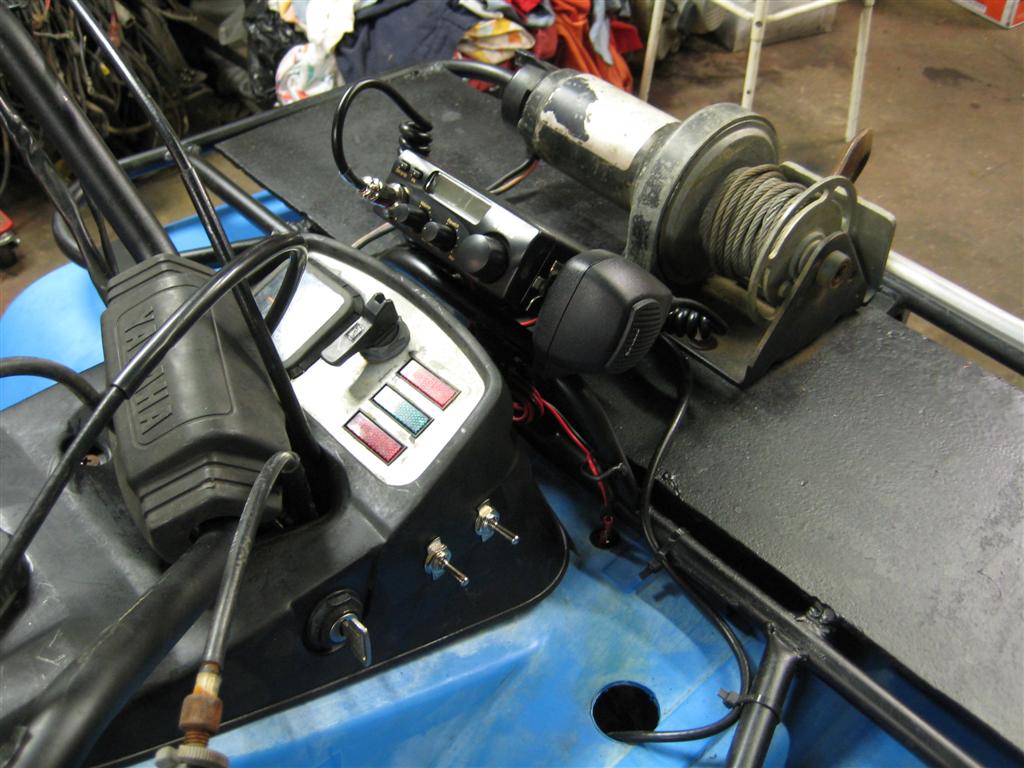
I generally utilize the same type of accessories on all of my utility ATV’s. Although I’m building this one to sell, I still may use it around the yard or as a backup until it sells, and I like to have all the features I’m used to. These include: auxiliary lighting (specifically on the rear), CB radio, and a good winch.
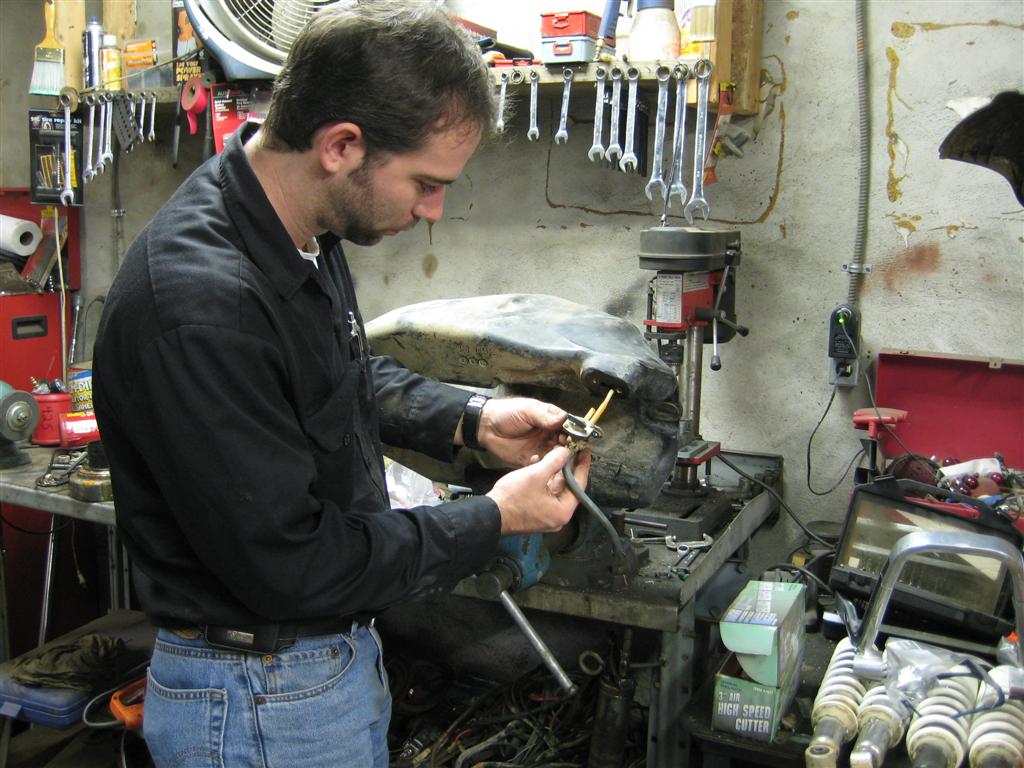
I started with the winch. This ATV already had a winch, but not much more. There was no auxiliary winch solenoid or wiring. The winch was an old-school 2,000 lbs Super Winch mounted to a thick steel plate on the front rack. It worked great but needed to be wired properly. First, I needed a solenoid. I had a good single-wire unit on the shelf, likely from a Polaris. I found a place to mount and ground it to the frame. Then I wired from the winch, where the main operation toggle was located, to the battery. I then wired a master On/Off switch so the solenoid would not engage and the winch could not be operated unless the main switch was in the “on” position. This is a safety feature that prevents the winch from accidentally engaging when not in use.
Winch Solenoid
Installed
Once the winch was taken care of, I proceeded to the other accessories:
Light and CB Radio
I installed the CB radio and antenna. The radio is a Cobra 19 Ultra III. It actually talks very well for a less expensive radio. The idea is to use a small, less expensive radio, not because I’m cheap, but because it will see rough service and potentially some weather, so if it breaks you do not want to be using a 29 LTD Classic. Next I installed the rear light and wired it to a toggle switch next to the master switch for the winch.
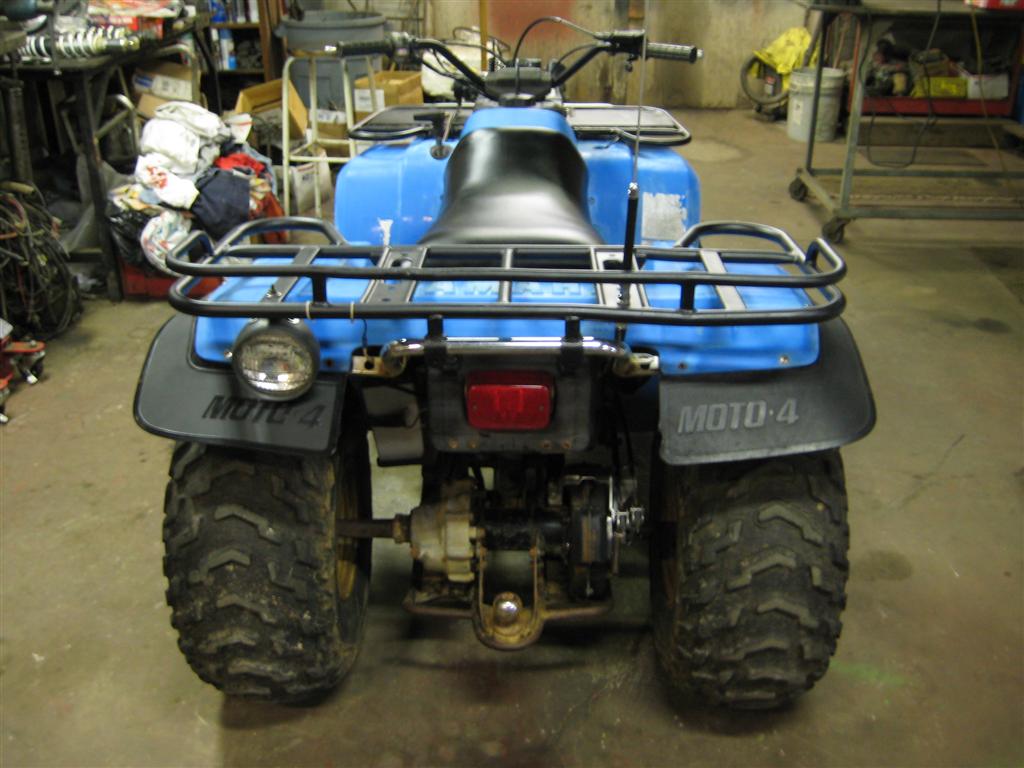
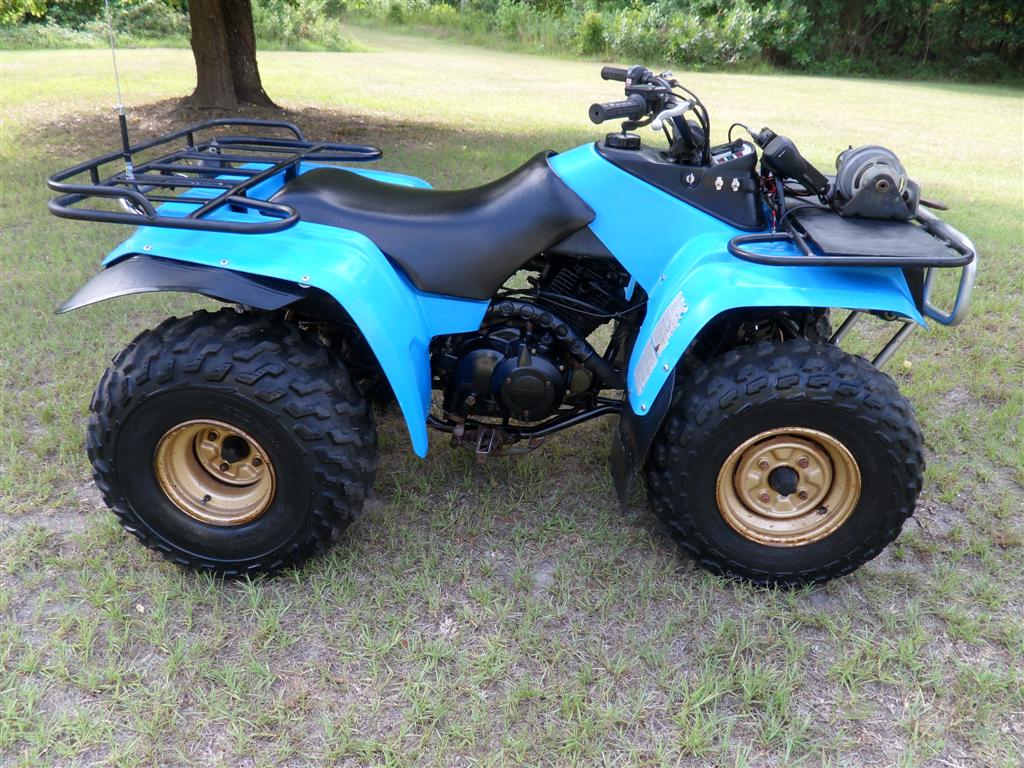
And that pretty much concludes this long ordeal of a project. I kept the quad for a few months, using it around the yard. It was a smooth riding machine with a very tight turning radius. I really enjoyed it. In fact, I would have liked to have kept it for a yard quad, but I’m limited on space so I had to make room for the next one. Here’s what it looks like now…
My total parts and supplies bill was very nominal, and after enjoying the quad for a few months, I sold it for $1300. Although the whole thing snowballed into much more than I had anticipated, it was a fun, profitable project. That’s all I can ask for. On to the next one!
It’s been a while since I’ve had time to post, and my loyal readers, like all two of them, have requested more posts. It’s just that fall and spring are my two busiest seasons, so I haven’t had much time. However, I did manage to go on a short hunting/riding trip the last weekend in October. I also completed some late summer projects that I haven’t posted yet, so there is some really good stuff coming soon.
From the ATC era of the mid 80’s up until the end of the following decade Honda and most of the ATV industry was void of any heavy-hitters, performance wise, for trail riding. Of course there were still some thoroughbred race bikes (although none from Honda after 1989), but for off-the-track trail riding you were very limited. The Honda options of the day were the TRX250X and later the TRX300EX, both only middle weight bikes. The 250X was a kick start model with a nice 4-valve single overhead cam engine with a 5-speed transmission. The subsequent 300EX was an electric start model with basically the same engine but with a lengthened stroke making the displacement a little larger. Yamaha had a leg-up on the industry, really in all categories race and trail, and the king of the sport trail bikes was the 350 Warrior which had a stout 2-valve single overhead cam engine with a 6-speed transmission. The paradigm shift occurred in 1999 with Honda’s introduction of the TRX400EX. But up until then, no manufacturer had produced a 4-stroke trail ATV with the bulk power, torque, and speed of the ATC350X last produced in 1986. The industry had decent four-wheeled chassis but no major power plants aside from the Warrior, which was not superior to the 350X. So during that period, what could be done?
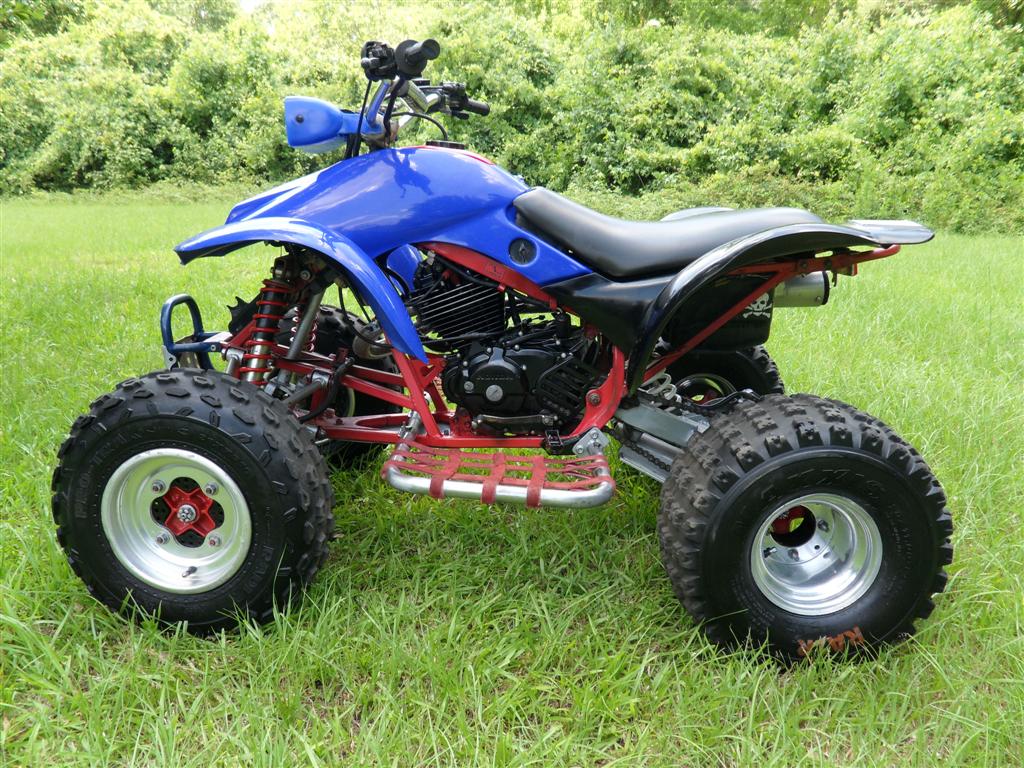
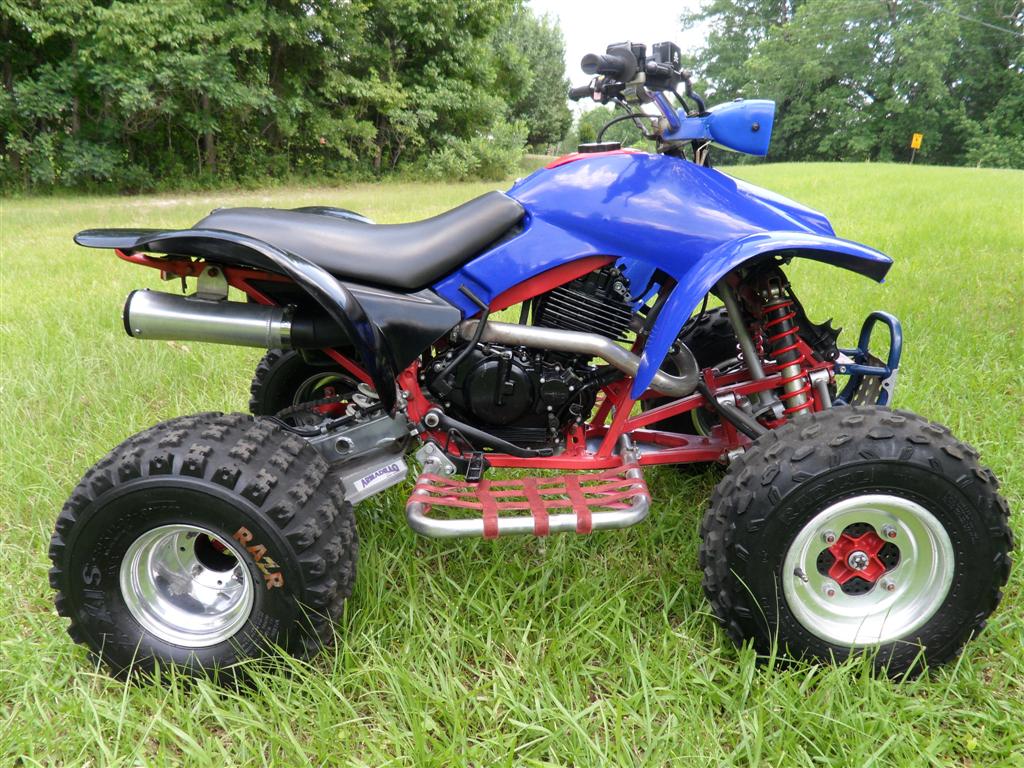
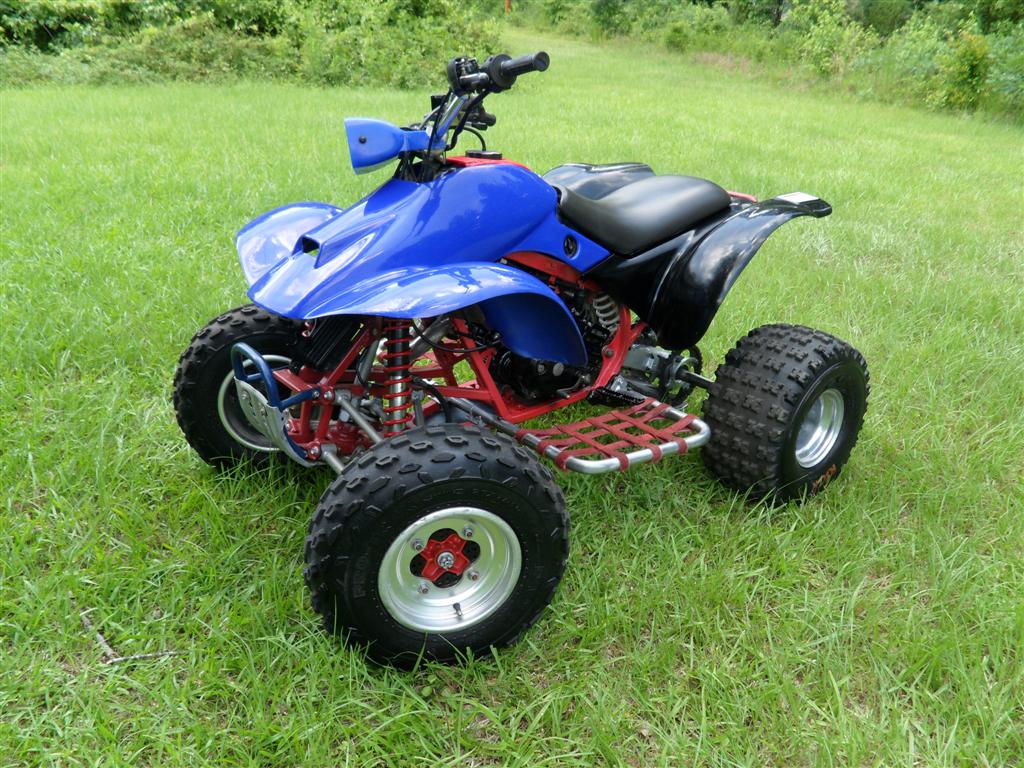
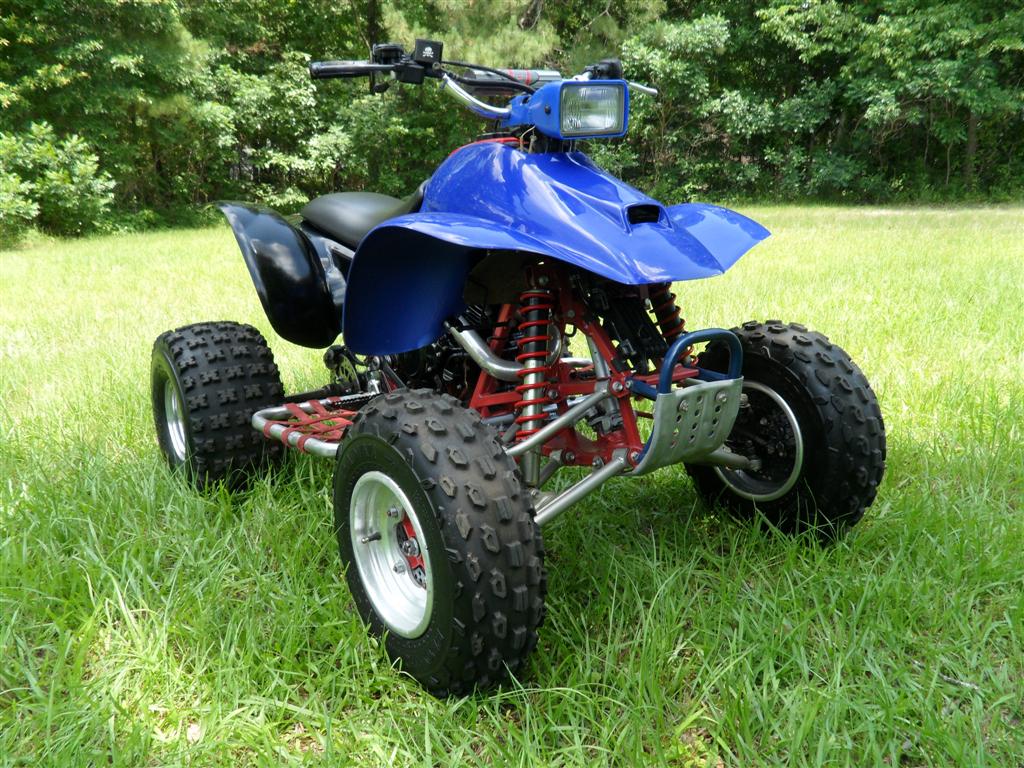
The answer: Well, in this case you can have your cake and eat it too. My choice, and the choice of many others before me, was to combine the best of both worlds with the exceptional, time-tested ATC350X power plant within the stability and performance of a four-wheeled chassis, specifically the Honda TRX250X. And thus the infamous Honda TRX350XX is born.
Mine of course has some major upgrades…
My project started in the winter of 2002, and although by that time there were some high-end four-strokes available, i.e. the Honda 400EX, Yamaha Raptor 660R, and the newly released Suzuki Z400, as a 19 year old, full time college student I didn’t have the means to go down and purchase a brand new ATV. Besides, it’s not my style to buy new machines; I like to build my own, and my favorite thing is to combine the past with the present. This was the ideal project for me.
As discussed in my 350X post, I got my hands on some ATC350X crate engines. The next step was to find a suitable ATV chassis, preferably something requiring minimal fabrication yet sporty enough for my riding style. While researching it on the web, my brother and I got some tips at Powroll and thus decided that a TRX250X chassis was the way to go. Fortunately, I knew someone who had a non-running 1991 250X. I easily obtained it for $500. We then ordered the Powroll conversion kit including the Shotgun series Supertrap 4 exhaust which at that time was priced at $565.00 total (the header was not stainless steel). And the project began.
The engine:
The 350X power plant is a kick start, 4-valve, single overhead cam engine with a 6-speed transmission (no reverse). My goal was to have an ultra-durable and super dependable bike that I could put lots of fun miles on with minimal maintenance. With this in mind, I wanted to keep the engine as close to stock as possible, but I installed some strategic upgrades. Although my engine had never been used, it had been setting on a shelf since 1986 so I wanted to freshen up the cylinder. I bored the sleeve and installed a Wiseco oversize piston kit which not only enlarged the displacement but also increased the compression ratio from 8.5:1 to 10.25:1. The next thing I did was upgrade the clutch with EBC friction plates and heavy duty Barnett springs. Then the engine was ready. These were moderate modifications that would increase performance without sacrificing dependability.
Intake and fuel delivery:
Initially I went with the 250X carburetor and a K&N air filter. I removed the lid from the air box for maximum air flow and jetted the carburetor accordingly. Later I installed a 400EX carburetor which has a larger diameter throat and got a noticeable power gain.
The chassis:
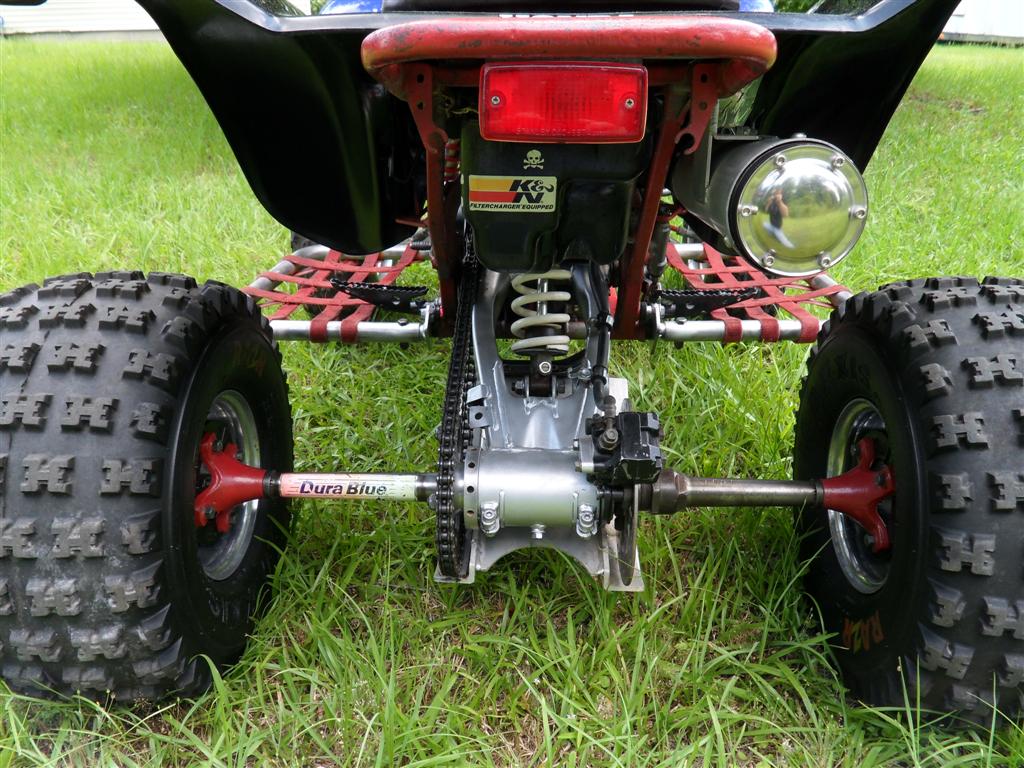
The chassis was pretty much stock when I received it. The only upgrade was a Dura Blue heavy duty rear axle. I left it that way initially but soon found it lacking, specifically in the suspension department. To remedy the issue, I installed front A-Arms from a 1989 TRX250R and front shocks from a 1999 TRX400EX. This widened the front substantially and gave me a lot more suspension travel. On the rear I installed an aftermarket mono shock with a remote reservoir and I added 6 inches to the width by installing Dura Blue polyurethane wheel spacers on the axle. For rear wheels I settled on 20×11-8 Maxxis Razor tires mounted on Douglas polished aluminum 8 inch rear rims. On the front I stayed with the stock rims and mounted a new set of radial directional tires that boasted a smooth ride with great handling. For the operator, I recovered the seat and installed Tusk brand aluminum handlebars with a padded cross-bar and gel hand grips.
At less than $1800.00 total investment, I had a good, competitive bike that easily held its own against the new $6,000 bikes. At that point it looked like this:
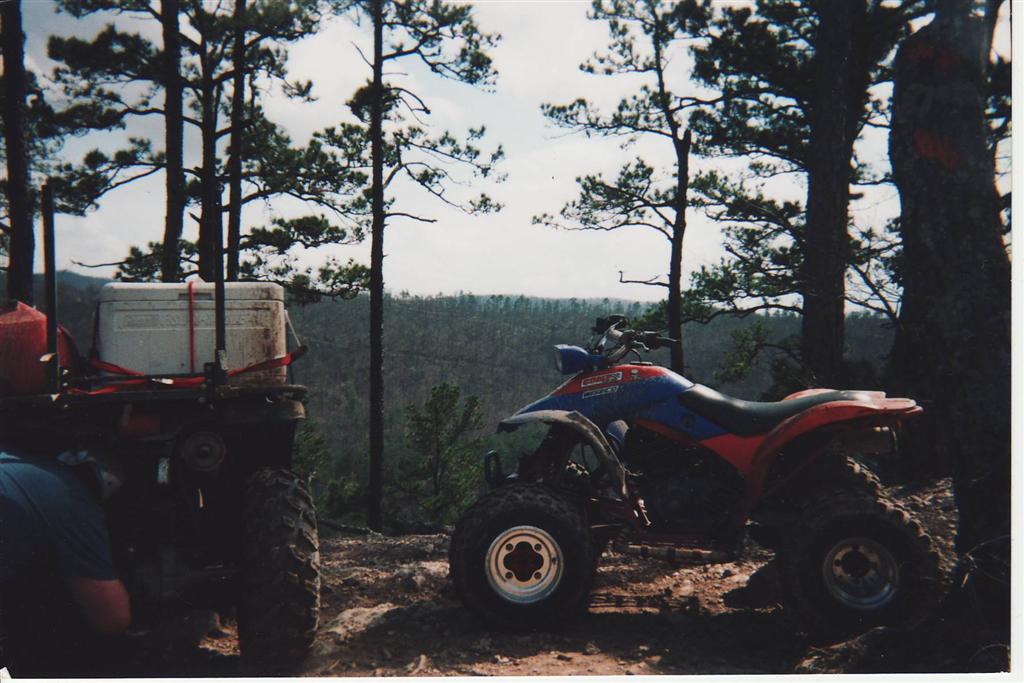
In the prime of my riding days, I took many trips and fun rides. We took trips to the mountains…
…and rode many trials and homemade race tracks doing tricks and big jumps.
But alas, as my core group of riding buddies slowly married and moved away our weekly rides had come to an end by early 2005. I rode the bike sparingly until about mid 2006 when it was placed in storage and remained there until a sunny spring morning in 2010. That day I pulled it out of moth balls, not to ride, but to reminisce. It was still fairly clean but it was much in need of cosmetic TLC. It hurt me to see it that way, so I trailered it to my shop and got to work. I removed all the plastics and began cleaning, polishing, and painting on the chassis components. But I didn’t stop there. I ordered all new plastics for it to give it the clean cosmetic finish I always wanted it to have but never had the chance to do it. Plastics for this bike are unusually expensive, more so than most other models. And at last, after almost 10 years I finally put the final touches on one of my favorite personal projects. I still have this bike today (back in storage) and it looks like this:






















 Nicholas Fluhart