Nicholas Fluhart

August 5, 2009

Honda Foreman 475 Omni Recovery ATV

Filed under: Bikes, Trikes, ATVs,Project: 475 Foreman — Nicholas Fluhart @ 1:45 am

What started out as a stock Honda 450 Foreman S is now the utilitarian king of my ATV collection. This is the finished product of an in depth rebuild project after about 16,000 miles…..yes that’s right; a bunch of miles and a bunch of hours. This page provides some general information on my particular machine. I’ve posted a few specs, equipment and accessory info as well as some pros and cons from my perspective. Overall, I have to say I am more than satisfied with the performance capability of this machine as it relates to what I wanted from a utility ATV. I wanted a reliable, bulletproof, machine that could handle everything from normal recreational riding to industrial applications. Check out theForeman project page for more on what went into building this bike. Also, here’s some history of the Honda Foreman line.

1998 Honda 475 S Foreman - Omni Recovery ATV

1998 Honda 475 S Foreman - Omni Recovery ATV

– Engine

The stock Foreman utilizes a 433 cc, longitudinally mounted, single cylinder, four stroke cycle, overhead valve, engine. During a massive and successful rebuild effort, I took the stock displacement and raised it to approximately 475 cc by installing a larger cylinder sleeve as part of a bore kit offered from Highlifter. Along with a high compression piston kit, the bore kit also came with a 480 grind Web cam. The goal here was to achieve the maximum possible torque for pulling and hauling and this configuration did the trick. Another great thing about this setup is it allows you to run the stock valve train and carburetor.

Pulling the Tractor

– Intake/Exhaust

This machine sees service in dry, dusty conditions, and in the interest of building an ATV for maximum durability and dependability, I went with a foam filter and pre-filter from UNI. On the exhaust side, I’m running a Supertrapp exhaust system specifically designed for utility ATV’s, meaning it’s not overly loud but it is free-flowing enough to unleash the power produced by the 475 cc engine. I’ve built, repaired, driven, bought, and sold a lot of ATV’s over the years and I believe this is the best sounding exhaust system I’ve heard on a utility ATV.

– Suspension

I’m running the stock suspension and ride height on this ATV, and for good reason. I built it for industrial applications that include pulling, hauling, and winching on extreme inclines. I do a lot of hill climbing, creek crossing, and driving through rough terrain. I need maximum stability in these situations and I found that the stock ride height could achieve this more effectively than using a lift kit because it keeps the stance low and wide. Although I don’t typically seek out deep mud, I often find need to go through it (usually to winch out other ATV’s) and I’ve never had any significant problems with ground clearance. However, if you are building a bike specifically for mud, a lift kit may be beneficial in allowing enough fender clearance for larger tires which provide more ground clearance. One thing to keep in mind with lift kits is they change the steering and suspension geometry which causes ball joints and CV joints to wear out approximately twice as fast as the OEM geometry.

– Brakes

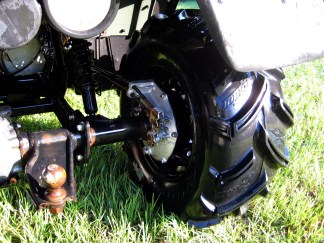
The front brakes are hydraulic drum type. As long as the wheel bearings and the drum seals are good, the hydraulic drum system works well. If the wheel bearings get slack in them it causes the drum to move against the backing plate and wear out the seal which then allows mud to enter and chew up the components. Unlike disk brakes which are self-adjusting, the drum type requires periodic adjustment. Aside from that, they are pretty much maintenance free because they are hydraulic. The rear brake is a cable operated mechanical drum type. Like the front, the key is to keep them clean. As long as the seals are good and you keep your cables adjusted, they provide good service. But if you don’t do that, they go down quick, especially if you ride in a lot of mud or water.
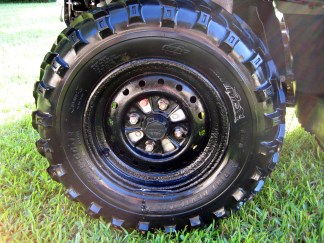
Front Wheel

Front Wheel

Rear Brake

Rear Brake

– Tires

The current tire selection was on the ATV when I purchased it. I typically prefer to run the same tire on both the front and rear, but after operating in a variety of conditions, I’ve determined it to be a very effective combination. On the drive axle I’m running 25 inch GBC Gator tires. The Gator is a 6-ply, aggressive, directional tire that operates well in soft terrain, and since the directional lugs overlap the centerline, it also offers a surprisingly smooth ride on hard surfaces. I rarely loose traction with these tires which make them great for pulling. On the steer axle I’m running 25 inch GBC Dirt Devil tires. The Dirt Devil is also a directional tire with overlapping lugs. Although the directional lugs aren’t quite as aggressive as the Gator, they do have very aggressive side-lugs that really assist in paddling through soft terrain. This formula not only provides excellent traction, it also provides a smooth ride which makes it easier on the operator. I’ve found them to be an excellent choice for a steer tire.

UPDATE: I’m experimenting with another tire combination. Check it out here.

UPDATE #2: I’m experimenting with yet another tire combination. Check it out here.

– Equipment and Accessories

Winch: No utility ATV is complete without a winch. I wanted a machine that could not only winch itself out of a bind, but I also wanted the ability to easily winch other ATV’s, equipment, logs, junk, or whatever else I may need to winch. Many ATV winches are mounted in locations on the bike that make them hard to access and use. I wanted to easily access and operate my winch with no hassel. With this in mind, I was also considering mounting two winches on the machine, one in front and one on the back. You never know which direction you may need to winch from and in critical situations, you don’t want to be limited on options. The logical solution is to have a winch on both ends of the machine. I had a 3,000 lbs winch and while looking for mounting solutions, I found a great multi-mount system from Warn. This allows you to use one winch that easily dettaches and reattaches to the front or rear of the ATV by using receiver hitches. The kit also comes with a dual wiring setup that has quick-connecters at the front and rear of the ATV which connect to one toggle to operate the winch. I typically use the rear mount for the transport/driving position to keep the winch out of the mud, brush, and debris. In the front, I have a D-ring hitch in the receiver. One thing to keep in mind if using the multi-mount setup: the rear receiver mounts in place of the tool box, so you’ll loose the factory tool box. To solve the ‘no tool box’ issue, I made some L-brackets and mounted a smaller tool box to the bottom of the winch mount. The new box (I think I got it from a ’97 Polaris Sport) is only a fraction of the size of the original box, but it’s enough to keep some vital tools.

Winch & Mount

Winch & Mount

4WD Selector: The 1998 model Foreman is full-time 4WD. To obtain the optional four wheel drive capability, I installed a Warn 424 Select 4×4 selector (no longer in production). This is an ultra heavy-duty but low profile unit that replaces the front drive shaft and is operated by mechanical cable which allows the driver to disengage and re-engage the four wheel drive on the fly. Having the option of running the ATV in 2WD for normal riding allows for smoother drivablity and less wear on the drivetrain components.

CB Radio: Communication is a great asset when working or riding in remote locations. I installed a Cobra CB radio on the top of the instrument cluster and headlight housing by attaching the mount to the headlight guard. I ran the coax to the rear rack and mounted a 64 inch steel whip to the factory dune flag mount on the rack. Surprisingly, the reception distance is great. The radio is easily installed and removed by using the mounting knob screws that came with the radio, and I’ve wired a standard 12V power supply receptacle to the stock location on the headlight housing.

Controls

Controls

Auxiliary Lighting: I mounted a utility light under the rear receiver hitch and wired it to a toggle switch. It serves as both a reverse light and work light when using the winch or working around the rear of the ATV. 90% of my riding is done at night when it is cooler, so lighting is very important.

Rear Light & Tool Box

Rear Light & Tool Box


Skid Plates and Guards: On the front I’ve installed a diamond plate aluminum guard to protect the bumper and frame from rocks and to keep sticks and brush from being forced into the front portion of the ATV. I cut a small square for the receiver hitch. I’ve also installed a set of Oxlite steel A-Arm and CV boot guards to protect the A-Arms from rocks and the CV boots from sticks and brush. I’m using the stock belly skid plate and the stock rear differential skid.
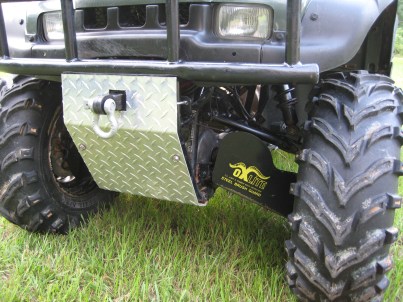
Front Guards

Front Guards

– Pros

This machine is very dependable. There’s never been a time when I couldn’t hit the switch and start it right up. With the 475 big bore kit, the torque is monsterous. You would be hard-pressed to bog this engine down. Before that happens, it will either loose traction or break something. It’s very impressive. The Supertrapp exhaust sounds great. The bike also has a smooth ride. If you spend much time in the saddle, you know how important ride quality can be. Overall, I’m very pleased with this ATV; it has exceeded my expectations.

– Cons

The only thing I can really complain about is the top cruising speed. The machine is geared really low and is obviously not a high-speed ATV because the Foreman line by it’s very nature is an industrial, workhorse type of ATV, but it wouldn’t hurt to have another high gear. When riding with other ATV’s on an open road, the Foreman has to work hard to keep from getting left behind. With the tires I’m running, the highest comfortable cruising speed is just a little over 30 mph. It will go faster, but I wouldn’t want to hold it at much more than about 38 mph for any amount of time. The fastest I’ve run it is about 50 mph.

You may also be interested in the Honda Foreman 450 to 475 project page here.

July 28, 2009

Project: Allis-Chalmers ACP80 Forklift (Part 2)

Filed under: Project: AC Forklift,Trucks & Equipment — Nicholas Fluhart @ 9:37 pm


Finished

Cosmetic Restoration

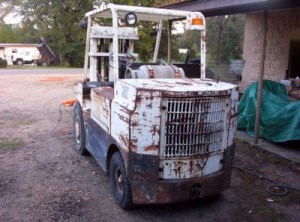
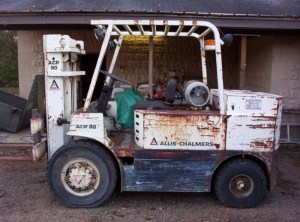
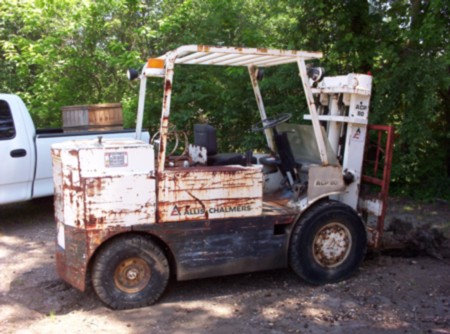
Now it’s on to cosmetics. I wanted the machine to look as good as it runs so I figured it was time to give it the liquid rebuild. From the factory, this forklift was construction yellow with black and orange decals. At some point in it’s life it was painted by a dealer white and black with new decals. Although they did an excellent job, it was now outlived and time for me to restore it. The overall quality of a finished product is directly impacted by the preparation.

It wasn’t my intention to produce a show-quality forklift but I also didn’t want a shade tree job. I planned to use the machine regularly and it would be out in the weather most of the time. With this in mind, I needed a good quality job that would hold up to the weather but not one that would require months of sanding, filling, and priming. I decided to stick with the white and black color scheme. I purchased a gallon of white industrial enamel and a quart of black. The great thing about industrial enamel is its ease of use. It thins with mineral spirits and can be applied with a sprayer or brush depending on the application. The surface doesn’t have to be perfect, but as with anything, the smoother the better.

Preparation

I started by pressure washing the metal to clean any grease or oil from the surface. I then began stripping the old layers of paint with a 4 inch cup brush on a grinder. The brush was coarse, but not so much that it would damage the metal surfaces. I stripped the sheet metal components, such as the engine compartment covers, down to bare metal. The solid steel surfaces, such as the counter weight and mast, received a smoothing over and removal of any rust or loose paint. The cup brush also served well to remove the old vinyl decals. Once the surfaces were appropriately stripped, I washed the unit again to remove the dust. I then primed all the bare metal areas and followed that up with wet sanding.

I don’t have detailed photos portraying each step of the process, but I did manage to snap a few shots of the project.

Beginning the Process

Beginning the Process

Using the Cup Brush to Strip Paint

Using the Cup Brush to Strip Paint

Paint and Decals

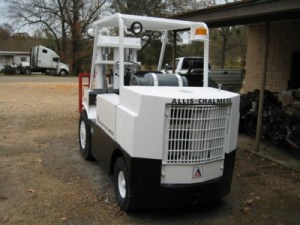
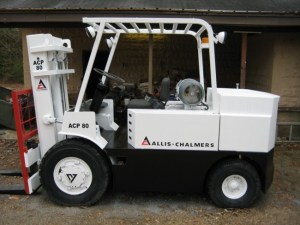
Now that I had it ready for paint I assembled my gravity feed spray gun. It’s a low cost paint gun I purchased at Harbor Freight out of curiosity. I found that it worked surprisingly well so I decided to use it on this project. I applied 3 coats of paint as evenly as I could across the machine while waiting the appropriate time between coats. A day or so after the paint was dry I began to apply the new decals. While it’s fairly easy to find decals for farm tractors, it is very difficult to find decals for construction/industrial equipment. I was able to find the long “Allis-Chalmers” decals seen along the side and rear on eBay. The rest of the decals were custom made. I took photos and measurements of the old decals and emailed them to a sign shop who was able to reproduce them. They worked perfectly.

Below are some “before” and “after” photos of the forklift.

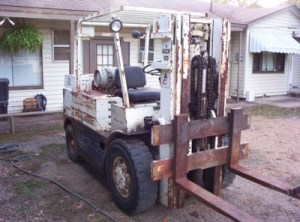
Before

Before

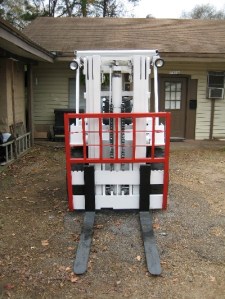
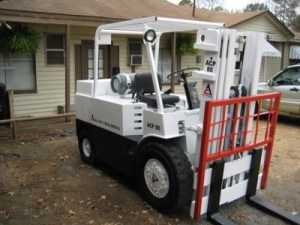
After

After

Before

Before

After

After

Before

Before

After

After

Before

Before

After

After

Finished Product

Finished Product

See the Allis-Chalmers ACP80 Lift Truck page for the specs of this machine.

July 25, 2009

Project: Allis-Chalmers ACP80 Forklift (Part 1)

Filed under: Project: AC Forklift,Trucks & Equipment — Nicholas Fluhart @ 9:35 pm

Here’s one of my favorite projects. I love Allis-Chalmers equipment. AC has a rich history in industrial manufacturing that spans far beyond the classic orange farm tractors that rolled from West Allis until the 1970’s. It’s a history I’ve studied extensively and I’m a big fan of Allis-Chalmers construction machinery and industrial equipment. This old ACP80 is currently the crown jewel in my Allis-Chalmers collection.

Before

Before

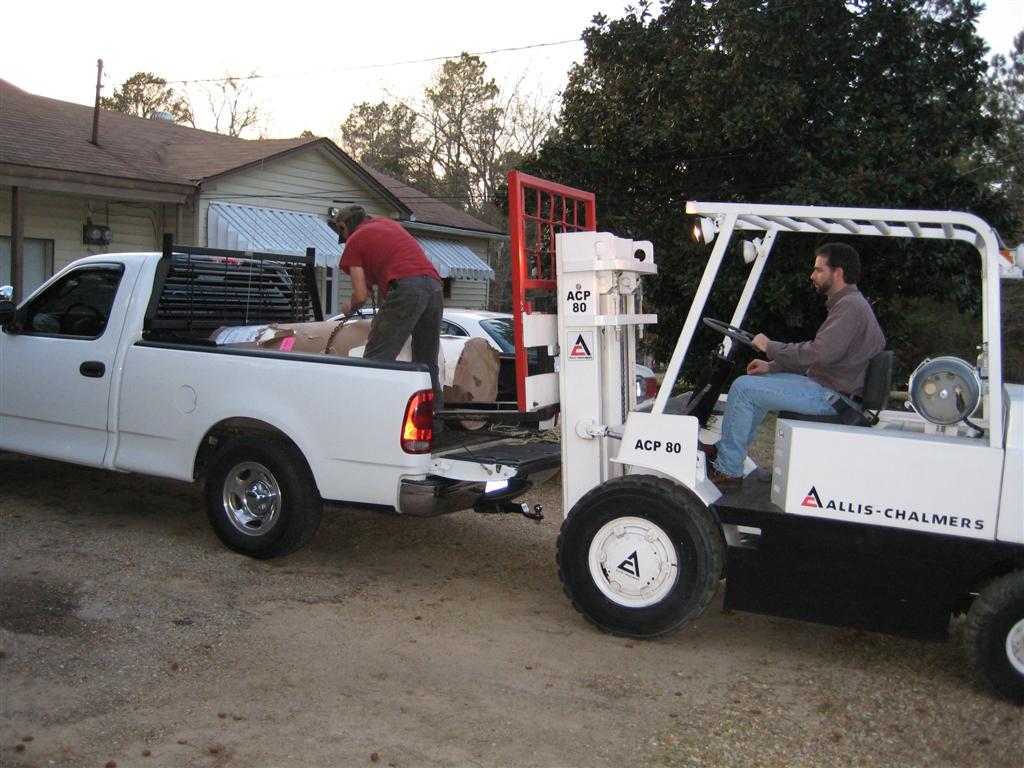
After

After

If you consistently do any type of physical work, you have to have a forklift. And once you’ve had one, you can never go without one. Simply put, it’s as handy as the button on your shirt. It wasn’t long after I had gone into business I knew the first piece of equipment I needed to buy was a forklift. One day my brother contacted me from an employee-only surplus auction at his workplace and described this unit over the phone. It sounded interesting so I gave him a max bid. As it turned out, we won the bid at $1000 which was a few hundred more than my max that I initially wanted to give for it sight unseen and not running. I was a bit nervous, but scrap prices were very high at the time so I figured worst case scenario I could sell a few parts off of it and scrap the rest to recover my investment. It was bound to have some good parts, and weighing in at almost 13,000 lbs it shouldn’t be a problem.

Just unloaded

Just Unloaded

My Initial Take

We had it hauled in on a lowboy and that was the first time I saw it. I was excited. It didn’t run and it looked like trot-line weight, but I was excited. I could see potential in the machine. The hour meter showed only 1600 hours which isn’t bad for a 1981 model. The levers and pedals showed very little wear, another sign of low hours. It has large pneumatic tires so it wouldn’t have any trouble negotiating the gravel area in front of my shop. It has an 8,000 lbs lift capacity and a 3-stage mast which should handle just about anything I would need it for. I was somewhat optimistic.

Diagnostic Inspection and Repair

One thing I noticed was all the fluids were crystal clear and the filters were marked with service dates which indicates it was fleet maintained. I learned it was kept and used at a storage facility and was not used on the daily production lines. This explained the low hours. I was told the unit gradually became hard to start and when they tried to fix it, the problem became worse. They parked it outside and left it for about two years before I purchased it in 2007. When I opened the engine compartment I noticed two immediate issues. 1) The electrical wiring had been butchered. Apparently they must have thought the problem was electrical or ignition related so they began rerouting wires without hesitation or qualification. 2) There was a small hole in the main LP gas line. This might have been the initial problem. It was primarily due to age, but the hose was also misrouted which caused it to rub on other components.

Before going much further I wanted to run a compression test so I wired to the starter directly in order to spin the engine over. The Continental F245 6-cylinder engine had excellent compression. This disbanded initial concerns that low compression may have been the cause for hard starting. This gave me the encouragement I needed to move forward, so I began rewiring the machine. Once rewired I installed new plugs, wires, ignition points, condenser, resistor, cap, rotor, etc. I replaced the LP gas lines and installed new fittings. I disassembled the converter regulator to clean and inspect, and I finished the final odds and ends such as brake fluid and tire pressure.

The moment of truth arrived. I pressured up the fuel system and turned the key. It started right up! The engine ran smooth and quiet and maintained over 30 psi oil pressure at idle. I immediately began testing the hydraulics. It took a few seconds to prime but everything worked. Finally, I put it in gear and it began to move. It wasn’t long before I was driving around the lot and picking things up. I was very happy. I had a good, functional lift truck for a little over a thousand bucks.

See Part 2 of this project for the cosmetic restoration.

See the Allis-Chalmers ACP80 page in the Equipment category for the specs of this machine.

July 20, 2009

Allis-Chalmers ACP 80 Lift Truck

The Allis-Chalmers ACP80 is a heavy-duty conventional type forklift. I’ve owned this one, a 1980 model, since 2007 (see the ACP80 project page here) and have been pleased with its performance and dependability. Below are the specs and information I’ve accumulated for the ACP80. I’ve also posted some pros and cons based on my experience with the machine.

1981 Allis-Chalmers ACP80 Forklift

  • Produced by AC’s Industrial Truck Division in Matteson Illinois
  • Model: ACP80
  • Fuel Type: LP
  • Engine: 6-cylinder Continental F245
  • Horsepower: 76
  • Transmission: Borg Warner Oil Clutch w/High and Low Range
  • Approximate Weight as Equipped: 12,322 lbs
  • Attachment: 42″ Forks
  • Load Tires: 8.25-15 14-Ply
  • Steer Tires: 7.50-10 12-Ply
  • Mast: 3-Stage
  • Lift Height: 182″ (Approx 15 feet)
  • Lift Capacity: 8,000 lbs
  • Mast Backtilt: 8 Degrees


-Industrial Truck Division

Allis-Chalmers first entered the material handling industry when it purchased the Buda Company in 1953. Buda was a manufacturer of engines and material handling equipment. I believe the main interest in the acquisition of Buda was so AC could produce their own diesel engines for their crawler tractor line, but it proved to be a two-fold blessing. Until that time, the diesels used in AC crawlers were GM diesels, also called Detroit diesels. The acquisition allowed AC the capability of controlling the manufacturing of their own diesel engines, which was a major plus, but their entrance into the material handling industry was also very profitable. Later, AC lift trucks were produced under the Industrial Truck Division of Allis-Chalmers. AC did well in the material handling industry for a number of years and despite financial hardships faced by many capital equipment manufacturers in the late 70’s/early 80’s, AC managed to hang on to their industrial truck division until 1986 when it was sold to AC Material Handling Corporation, a privately-held company.

-Model

I’ve found it very difficult to obtain information specifically for the ACP80 unit, so this part is basically from my experience and may or may not be completely accurate. To summarize the dissection of the model number, I believe the “AC” in ACP80 refers to Allis-Chalmers, the manufacturer. The “P” appears to refer to the model being pneumatic tire equipped. Some have said it refers to the fuel type, propane. This is likely derived from noting other models, such as the ACE which is electric. However, I have seen many ACP’s that were gasoline and diesel. If anyone has more detailed information, please feel free to post it. The “80” refers to the lift capacity which is 8,000 lbs. The smaller and more common sibling, the ACP60, is a 6,000 lb lift and the ACP40 is a 4,000 lb lift, and so on. AC also made conventional types even larger with the ACP 100, 120, and 140.

-Fuel Type

LP or LPG (liquid petroleum gas) is my preferred fuel type for lift trucks. It burns clean, which allows engines to last much longer. This also minimizes noxious exhaust gases which serves well in close quarters where forklifts are commonly used. However, I would have to say the main reason I like it is its convenience. The system is sealed and easy to deal with. I don’t always use my forklift regularly, and with the LP system, I don’t have to worry about the carburetor gumming up or the fuel going bad or perhaps accumulating moisture between uses. Another plus.

-Engine

Continental engines are in a wide range of lift truck brands and applications as well as various types of industrial equipment. The Continental L-Head engines are old technology flat-head, points ignition type engines but are typically solid, bullet-proof power units. My ACP80 is equipped with a Continental F245 6-cylinder engine, which I believe produces 76 horsepower.

-Transmission

The Borg Warner oil clutch transmission, another common item in lift trucks, seems to be a solid unit. Borg Warner has long been a producer of industrial clutch and transmission related components. I’ve never had any trouble with mine. The ACP80 is equipped with a 2-speed unit that is handy when driving from point ‘A’ to point ‘B’, just shift it up in high range and it cruises at low RPM. When you get back to business, drop it down in low and it is responsive and powerful. At my place, I never really get into a position to use the high range. Low does pretty much everything I need, but the high range is a nice option to have when it is needed.

-Weight

A lot of weight is required to move heavy objects with stability. The ACP80 is a very weighty machine. I stuck mine the first day I used it. Even on a very hard packed dirt surface you have to be careful if you drive back through your tracks. The weight is concentrated on four narrow tires and you can literally feel the ground moving under you when operating the machine off-road. Even on concrete floors you need to take note of the slab depth; this thing will break concrete. Some models came with dual wheels on the load axle which would serve well off-road. My machine was intended to be used in tighter quarters and has the single drive wheels for better maneuverability.

– Attachment

The forks on this machine are heavy, 5 inches wide and 2 inches thick. The factory equipped forks are approximately 3.5 feet in length. The forks on my machine appear to be closer to 4 feet. Overall, they are adequate for this unit. In fact it could easily handle longer forks. I recently installed fork extenders on mine, making the length 5 feet.

– Tires

The data plate shows the factory equipped tires to be 12 ply. The load tires (drive tires) on my machine are 14 ply wide-walls. The wide wall design is to protect the wheel rims. Forklifts are often operated in tight areas and the rims can get scraped and bent. This is especially true on machines like mine that utilize Dayton wheels. The lugs tend to extend out a little bit further than rims with center lugs.

– Mast

A strong 3-stage mast is a great asset on any forklift. My ACP80 has a very heavily built but relatively short mast. The shortness makes it ideal for operating in a shop or warehouse where the unit may travel through doorways or under low ceilings, but to make up for the short height it has three stages. The overall lift height is about 15 feet. The lift capacity is 8,000 lbs, so it will handle quite a load. The mast tilts forward and backward but does not have side-shift, which wasn’t really common until later.

Unloading Two Paper Rolls Weighing 900 lbs Each

Transporting 900 lbs Paper Roll

– Pros

This is one of the most dependable machines I’ve owned. The great thing about the LP gas is it can set up for long periods of time and still fire right up when I need to use it, no matter if the weather is hot or cold. Another plus is the pneumatic tires. It can easily negotiate gravel and other hard surfaces in addition to paved surfaces. The ACP80 is actually considered an “all-terrain” forklift, not to be confused with “rough-terrain” forklifts which have much larger tires and are typically not of the conventional lift truck design. The transmission is smooth and the high and low range is nice. The 3-stage mast with tilt adds to the capability in service, especially when the machine can lift 8,000 lbs. Overall, very capable.

– Cons

For a conventional type forklift, it is somewhat large. You have to plan ahead because, compared to smaller units, it takes much more space for maneuvering than you might think. Also, it’s very heavy so you have to be careful where you operate it. If you get it stuck you’ll need something substantial to get it out. The tilting mast is great, but it was built before side-shift was common so you’ll have to be a good driver. One of the main drawbacks of having such a large mast is it severely limits visibility. It’s very difficult to see exactly where your forks are, so you need to have a good feel of the machine because you won’t be able to see everything.

Loading Scrap on 1979 Ford F-600 4x4

You’ll probably be seeing this forklift in the background of many other posts. At some point I’ll post some videos of it in action.

You may also be interested in the ACP80 project post here.

« Previous Page

Create a free website or blog at WordPress.com.