Nicholas Fluhart

September 17, 2009

UPDATE: Warn 424 Select on the 475 Foreman

Filed under: Project: 475 Foreman — Nicholas Fluhart @ 7:15 pm
Tags: , , , ,

After having used the Warn 424 Select 4WD selector on my 475 Foreman for over a year, I now have the benefit of offering my experience with the equipment for your consideration.

Pros:

The functionality of this part is actually very good. It is ultra heavy-duty and I have had no problems with the drive mechanism. It disengages and reengages with ease.

Cons:

The control mechanism. Specifically, the control mechanism is susceptible to corrosion. Some of the parts are brass, which is helpful, but the other parts are galvanized steel and corrode rather quickly making it impossible to operate the unit.

Concerning the control mechanism, the first sign of corrosion is that the knob begins to be hard to push and pull, but the worst part is the spring-loaded push button in the center of the knob. When you pull the knob out, the push-button is supposed to pop out and ‘catch’ holding the knob in the extended position giving you 2WD. It does this by utilizing a spring-loaded steel ball bearing that rolls on the inside of the control unit housing until it encounters a notch where it nestles nicely into place holding the knob in the extended position until the button is pushed releasing the ball from the notch allowing it to roll back down the length of the housing as the knob is pushed in and the 4WD is engaged. When the internal parts, such as the spring and notch, corrode the notch becomes full of junk and the spring is not powerful enough to hold the ball bearing in the notch. This results in the inability to hold the unit in the 2WD position, leaving it in full-time 4WD.

Maintenance:

I started to entitle this section “Solution” but as of now, I haven’t yet established an effective solution, however I plan to readdress the issue in the future and perhaps modify the spring and/or other components to achieve a permanent fix. In the meantime, here’s what I’ve done in the way of maintenance:

First, I soaked the unit in penetrating oil and began disassembly. This was harder than it sounds. The corrosion made it difficult to disassemble. Also, as you can see, I was working in tight quarters. My shop was full of operations with the purpose of making me money, so I had to settle for working on my hobby project out back.
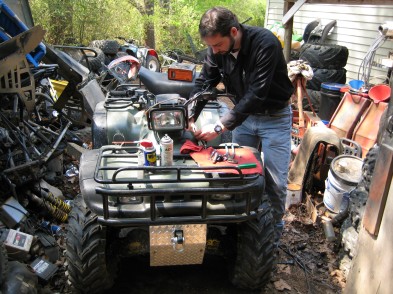
Removing the Unit

Below I’ve laid out the individual components of the mechanism. The brass center section and the housing seen setting just above it were the components most hampering operation of the unit. This was due to the unit becoming dry and developing corrosion and junk between the components.
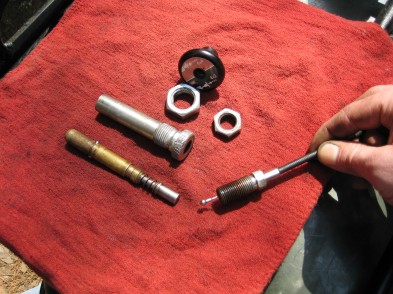
Components Laid Out Before Cleaning

Components Laid Out Before Cleaning

There really wasn’t much I could do other than to clean each component. I started by polishing the parts with a wire wheel on my 6″ bench grinder.
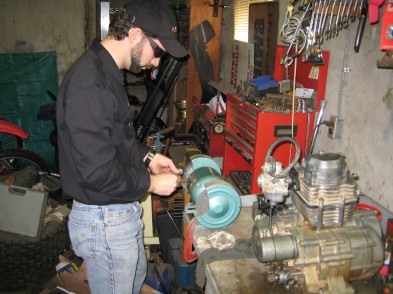
Cleaning the parts with a wire wheel

Cleaning the parts with a wire wheel

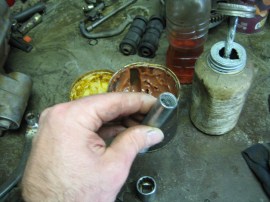
I then washed each part clean in my wash vat which uses clean solvent (mineral spirits) as seen below. Once I washed the parts I used compressed air to dry them before applying a coating of grease and anti-seize compound to prevent the corrosion issue from occurring again.
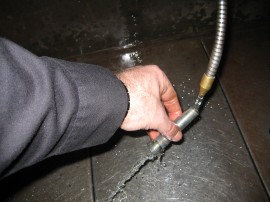
Washing the parts

Washing the parts in solvent

Applying Compound

Applying Grease and Anti-Seize Compound Accordingly

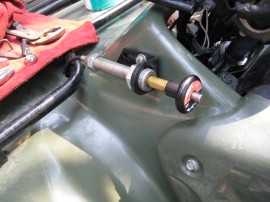
Now I was ready to go back together with the unit. You can see the cleaned parts laid out below. Note the mounting bracket bolted on the fender. I had to readjust it to keep the headlight guard from catching on it during tight turns. To the right you see the finished, mounted mechanism.
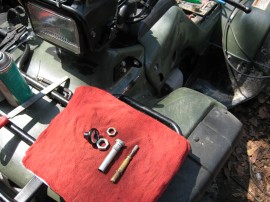
Ready for Reassembly

Ready for Reassembly

Finished

Finished, Mounted Mechanism

Conclusion:

The unit worked perfectly after the maintenance I performed. However, after a few weeks I began having an issue with the push button. Although the mechanism still operates smoothly due to the enhanced lubrication compound, it appears that the main push-button spring isn’t quite strong enough to pop the button out when the knob is pulled out to the 2WD position. As of now, and until I have the time to reevaluate the parts, I carry a small pair of pliers and simply grab the end of the button and assist it by gently pulling out until it catches. This sound silly, and it is, but it’s actually easy to do on the fly.

Until next time…

UPDATE:

I removed the pull knob and found that corrosion from the steel push button had built up in the aluminum knob. I cleaned and oiled the parts, and now the entire mechanism works as it should. This is great because I was getting tired of the carrying around the dumb pliers.

August 31, 2009

UPDATE: Project Recon

Filed under: Project: Honda Recon — Nicholas Fluhart @ 12:30 pm

So far, the Recon project has been a success and I have a buyer lined out. The engine runs smooth and quiet and overall the bike performs well. However, after getting a chance to operate it, I noticed it developed a popping sound on the right front. The sound became exceptionally worse in reverse. At first glance I thought it was a brake issue, but when I applied the brake the sound remained the same which means it likely isn’t the brake. The only other thing it could be is a wheel bearing issue. Perhaps I had incorrect bearings? Well, not exactly.

Getting Started

Getting Started

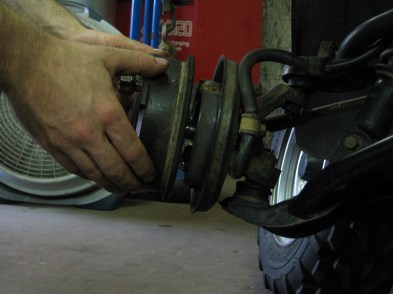
So I pulled it up in the shop and slid a jack under it to remove the wheel. I buzzed the wheel off with the impact wrench, removed the cotter pin from the spindle, removed the nut, and slid the brake drum off.

Removing the Drum

Removing the Drum

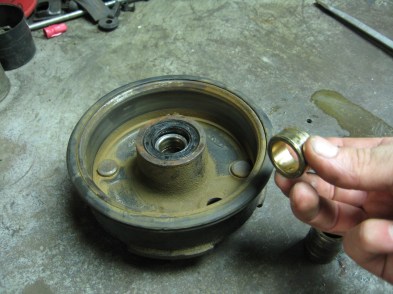
When I removed the drum, there really wasn’t anything immediately noticeable. Everything looked functional and I could see no obvious damage. So I turned my attention to my initial concern: the bearings. Again, nothing obvious jumped out at me, however upon closer inspection I could see that the bearing collar, which serves as a spacer between the two bearings, was a little more loose between the bearings than I’d like it to be. Although it’s a simple spacer, it serves an important function. These ball bearings are not tapered and they cannot take any amount of side-load on the inner race. When the drum/hub is installed and the spindle nut is tightened, the collar keeps the inner races of the two bearings from getting mashed from the side. It holds the races evenly under the load. If the collar is worn on either end, which usually occurs if the hub was at one time operated with a defective bearing, the races will be subject to a direct side-load and immediately begin to bind. To test my theory, I reinstalled the hub and tightened the nut. Instantly I could feel that the more I tightened the nut, the more I could feel a drag on the bearings until they began to bind. The next step was to pull the bearings and replace the collar. Fortunately, I happened to have a new collar on the shelf from a previous part-out job, so that saved me from having to make one from scratch.

The New Collar

The New Collar

Only one bearing and seal needed to be removed in order to replace the collar. Once I had the hub on the bench I proceeded to remove the inside seal and bearing. The challenge here was to keep from damaging the seal which I just recently installed.

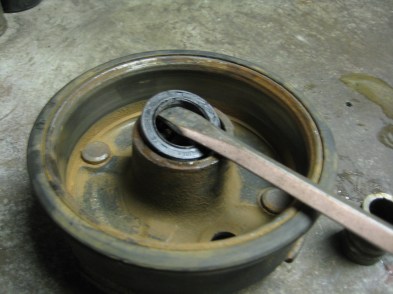
Removing the Seal

Removing the Seal

I used a wide flat head screwdriver to gently remove the seal in a circular pattern. I then proceeded to remove the bearing. Note: The seal could also have been removed at the same time as the bearing. As the bearing is pushed out it will typically push the seal out as it goes. However, it can sometimes complicate bearing removal and since I planned to reuse the components, I didn’t want to smack the bearing any harder than I had to.

Removing the Bearing

Removing the Bearing

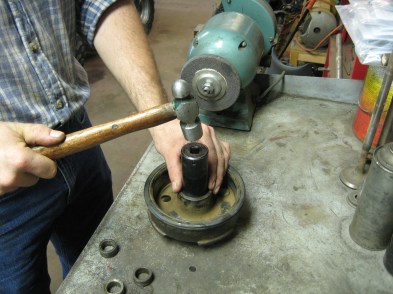
After I removed the old collar I inspected both bearings which I had just recently replaced during the rebuild project. Fortunately, I noticed the noise immediately upon operating the ATV and was able to catch it in time. Both bearings appeared to be in good condition. They turned smoothly and had no slack. I installed the new collar and reinstalled the bearing and seal. Ideally, it is best to use a press to install bearings. However, when one is not available you can use something with the same outside diameter as the bearing to tap it into place. You never want to smack the center race. In this case, I used a socket.

Reinstalling the Bearing

Reinstalling the Bearing

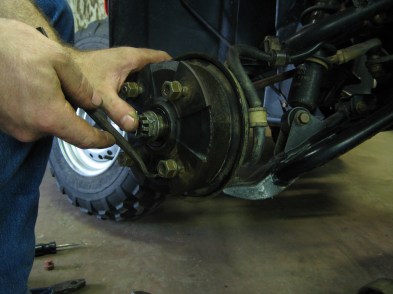
Once the components were all inspected and reinstalled, I installed the brake drum back onto the spindle and reinstalled the castle nut. I spun the hub and it worked perfectly. The nut was good and tight but the bearings had no excessive drag and turned smoothly. Mission accomplished. I installed a new cotter pin through the castle nut.

Installing the Hub/Drum

Installing the Hub/Drum

When the drum was properly installed, I began adjusting the brake shoes. I pulled the rubber inspection plug in the drum and used a narrow brake spoon to work the adjusters.
Adjusting the Shoes

Adjusting the Shoes

I adjusted the shoes until they maintained the proper drag on the drum, then I reinstalled the wheel.

Finished

Finished

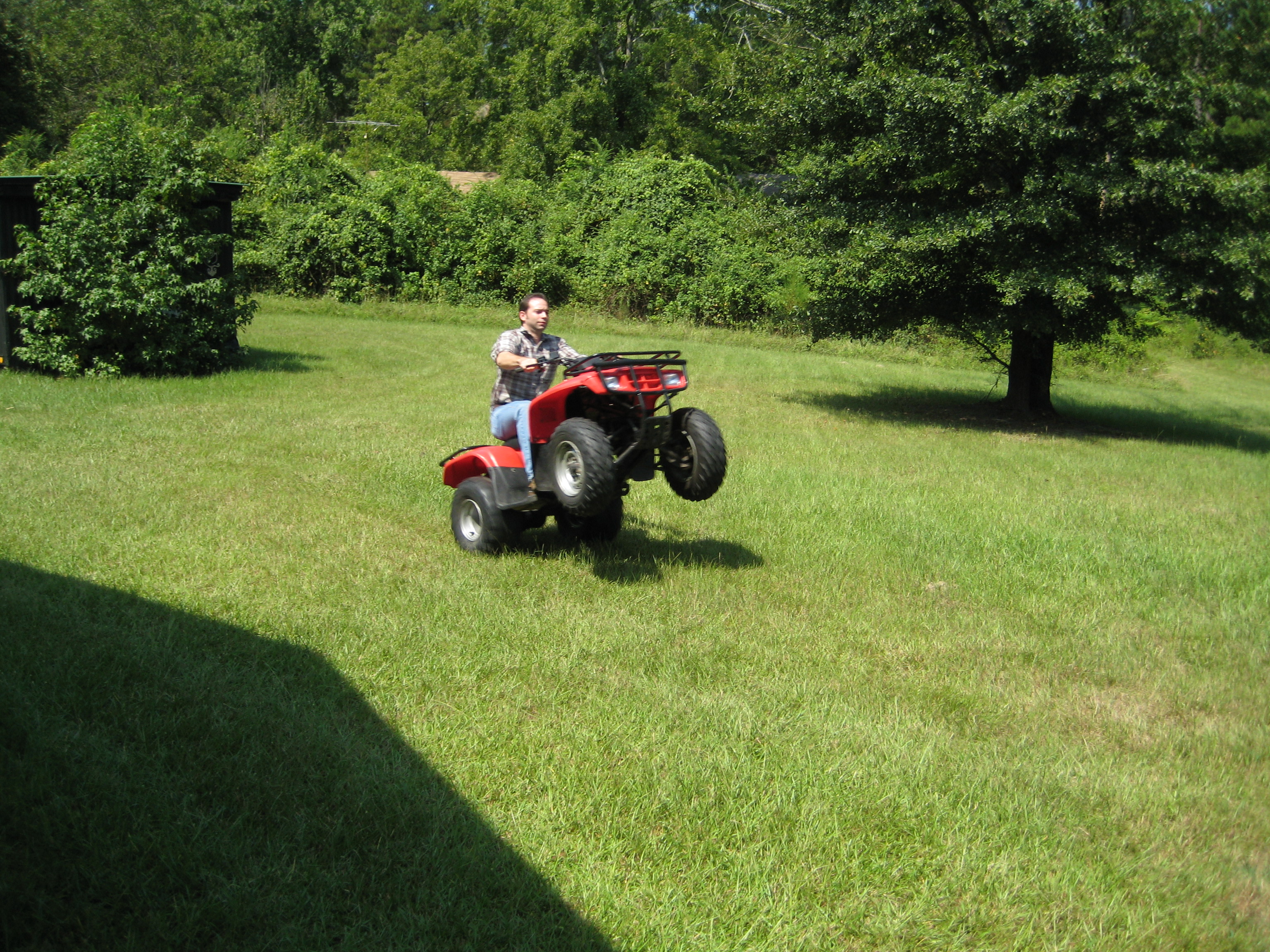
After I completed the repair, it was time to put it through the paces, after all, I have to make sure it will hold up through a variety of service environments.

Mandatory Testing Procedures

August 15, 2009

Project Recon

Filed under: Project: Honda Recon — Nicholas Fluhart @ 8:27 pm

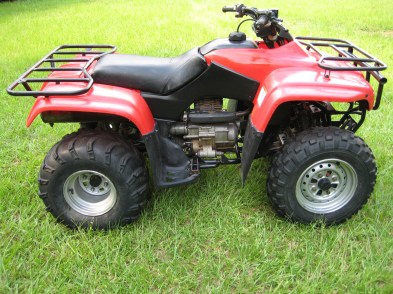
I thought I’d make a post on a project I recently completed. It’s nothing out of the ordinary, but it turned out to be much more involved than I initially anticipated, as is usually the case with most projects. This is a 1998 Honda Recon 250 that I purchased late last year.

1998 Honda Recon 250 - Finished

1998 Honda Recon 250 - Finished

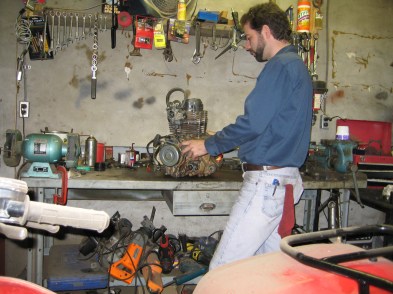
I bought it for $350 with the intention of fixing a few things and selling it for around $1500. That’s pretty much what I did, but I ended up fixing a lot more than I intended to fix. When I purchased it, I knew it needed a quick top-end rebuild, front brakes and wheel bearings, but the main thing it needed was to determine why it wouldn’t shift out of neutral. I have some experience with these engines and knew that sometimes the internal linkage could wear and bind which causes it not to shift. This is usually an easy fix. It’s best to pull the engine but you typically don’t need to split the main cases. I figured since I had to put a set rings in it, I might as well pull the engine anyway, so that’s what I did.

At the Bench

I removed the top end and side cases and began inspecting the shift linkage. This is where the first round of unexpected repairs began. I couldn’t see anything wrong or worn which was bad news because that meant the problem may be in the transmission and I would have to split the cases, so I did. And again, I couldn’t see anything wrong. I inspected the shift drum, forks, guide rail, and the dogs on the gears. Everything looked great. I reassembled the main cases, tried it again and I was able to shift it by hand perfectly. This was confusing. Clearly, something must have been in a bind and was now free. However, this was concerning because I didn’t actually repair anything and it could potentially fail again. It was at this time I decided to replace the whole gear set and linkage in the transmission to be on the safe side. Fortunately, a friend had a transmission he was not using so I was able to get everything I needed. Finally, hours of disassembling, reassembling, dissembling, and reassembling again, I completed the engine.

Completed Engine

Completed Engine

After I finished the engine, I went ahead and replaced the front bearings and seals, went through the drum brake assemblies and hung new springs and shoes. Although the rear brakes had new shoes, they didn’t work that great, so I disassembled them. That’s where the second round of unexpected repairs started. During inspection I found that the axle splines for the wheel hubs were worn almost completely smooth and the axle bearings had slack. So I pulled the axle and housing as well as the differential. It’s fairly easy to install axle bearings in a differential, but as I disassembled it I found that the pinion bearing also had slack. Pinion bearings require special tools and a lot of finesse. Fortunately, the gears were in good shape. What is more fortunate, is that I had just purchased another Recon for $100 and it had a lot of what I needed on it (I wish I had it back when I was working on the transmission).

On the Floor

After finishing the chassis, I put my attention back on the engine and installed it.

In the Frame

Once installed, it fired right up and ran perfectly. After it was all over, I had pretty much rebuilt the ATV from front to back, including a lot of cosmetic stuff. It turned out to be far more than I wanted to do and far more than I had time or energy, but when I finished I still only had about $650 or $700 in it, total. It took about five months working here and there in my spare time.

Finished

Until next time…

August 11, 2009

TCB at OmniSales

Filed under: Day to Day — Nicholas Fluhart @ 11:46 pm

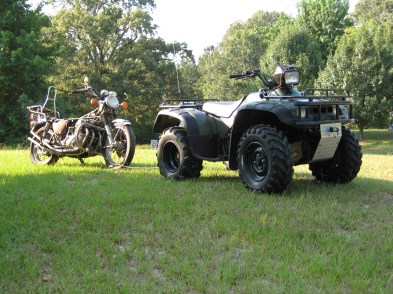
I recently purchased a 1975 Honda CB750 for a part-out machine. It had been setting in the weather non-running since 1997. These bikes are very heavy, so to get it from the yard to the shop I employed the Omni Recovery ATV (I know…big surprise) to bring the bike to the chopping block.

Pulling the CB750

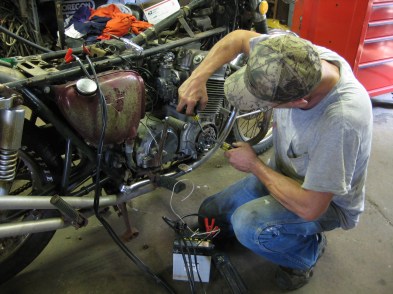
The most valuable part on this particular motorcycle was the engine. Typically, we disassemble engines and sell the parts, but in this case the engine was worth more whole which also saves me on labor costs. But before removing the engine, I wanted to see if we could get it running. If it would run I could get a video clip of it running for our remote buyers to see. I had my mechanic go through the carburetors and re-work the ignition points.

Will it Run?

Were we successful in getting this bike running after having set in the weather for over 15 years? Well, check out the clip below and see for yourself.

Of course we got it running, we’re professionals…or at least that’s what we like to call ourselves. Anyway, I was able to sell the engine to a buyer in West Virginia. So now the next step upon removing it was to weigh it for shipping.

Weighing Engine

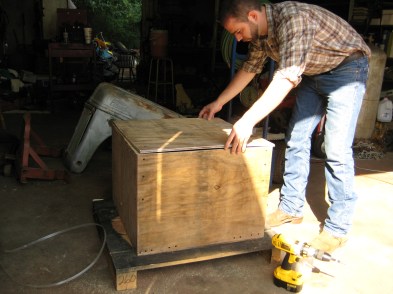
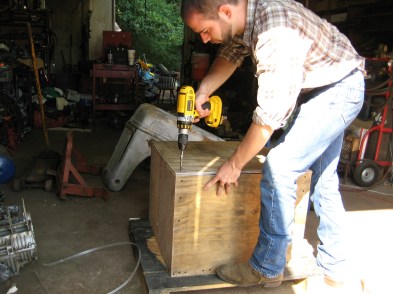
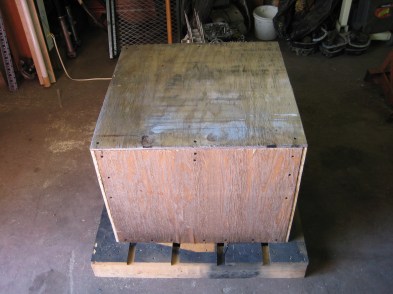
Now it was time to prep it for shipping and crate it up. I didn’t have a suitable crate so we decided to build one.

Making Measurements

In the Crate

Capping it Off

Sealing it Up

Finished Product

Now it’s time to fill out the papers, arrange the shipping, print and apply the labels, and arrange the pickup.

Ready to Go

On it’s way to West Virginia to a happy buyer!

On it's Way!

All in a day’s work here at OmniSales International.

August 8, 2009

Project: Honda Foreman 450 to 475

Filed under: Project: 475 Foreman — Nicholas Fluhart @ 9:18 pm

Most of the ATV’s I’ve owned (my personal ATV’s I buy to keep, not to be confused with the many ATV’s I buy and sell as part of my business) have been sport or racing bikes, so when I had the opportunity to purchase this 1998 Honda 450 Foreman I envisioned building a magnum industrial/utility machine. And that’s just what I did.

Before

After

I had a friend who received this ATV from his cousin who is a poultry farmer in northern Arkansas. The ATV was used daily on the farm and from 1998 to 2004 acquired over 15,000 miles. Yes, that’s a lot of miles for an ATV. But even harder to believe is the engine, differentials, and axles were all completely stock and in good condition.

Lots of miles and lots of hours

Lots of miles and lots of hours

That was until he handed the key to his son who promptly sunk it in a mud hole and drowned out the engine. He brought it to my shop and I completely rebuilt the engine from top to bottom. A few months later the same thing happened again. This time, due to the digestion of sand and sediment, other components in the engine were beginning to fail, such as the cam chain adjuster and the clutch. Rather than continuing to dump money into something his son would systematically destroy, he decided to sell it. I offered him $500 and he gladly took it. I knew I could part it out for twice that amount, so I felt safe with my offer.

– Initial Inspection

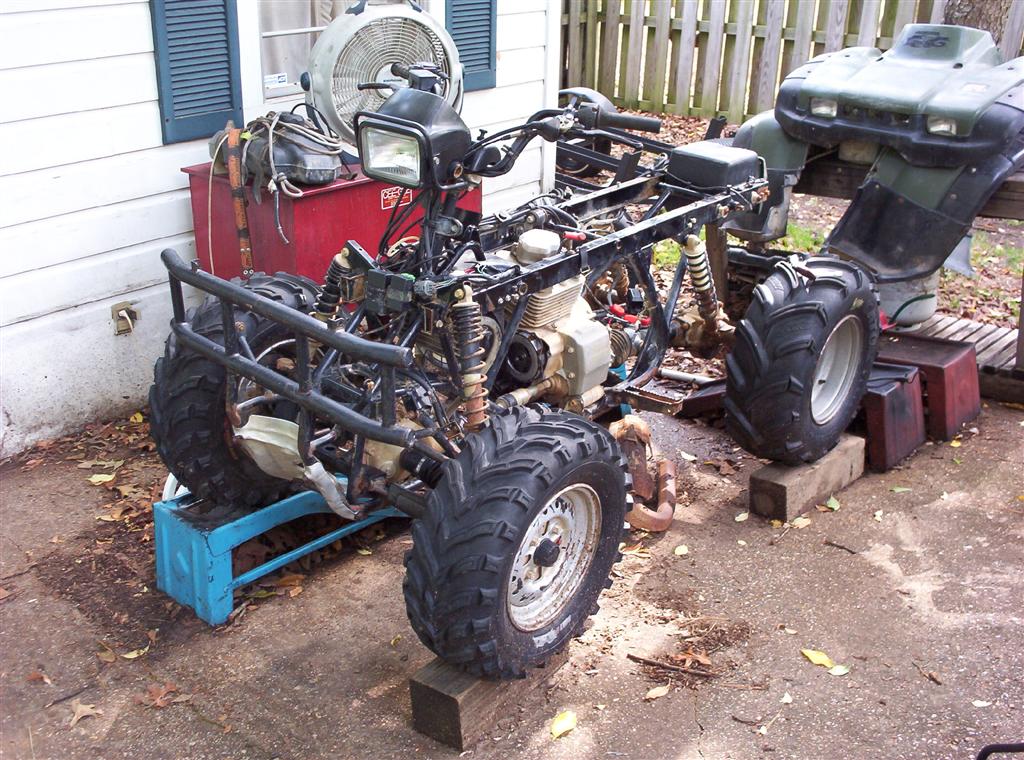
Now it was time to inspect the machine from front to back and determine if it would be worth restoring and what parts would be needed. I knew the engine would need a complete overhaul, but the axles and differentials were sound. It did, however, need most of the bearings replaced and both front and rear brakes needed to be completely rebuilt. I obtained parts pricing from my extensive parts networks and calculated it would need about $500 in parts. I estimated an additional $500 may be needed for unseen damage and the many accessories I planed to install. This would put my total investment at $1500 and I would have a completely rebuilt, ready to ride, excellent ATV loaded with all the accessories and equipment I needed, like which I could not have bought one for that amount. Of course, as with many personal projects, you can’t really put a dollar value on your time invested. It has to be a labor of love.

– Chassis

The first thing I did was strip it down to the frame. The frame consists of square backbone rails and round tubing. Frames can easily rust through in places unseen, so I painted the entire frame in a semi-gloss black. On the front, the A-arm bushings and ball joints were in good condition so I just painted the A-arms. I inspected, adjusted, striped, and painted the tie rods in a low-gloss silver. The front axles and boots were in great shape, but I did have to replace the wheel bearings and seals. The front differential was in excellent condition and clean inside so I polished the exterior to a shine and applied a clear coat to prevent oxidation. I performed the same procedure on the rear including replacing the axle bearings in the axle housings.

One thing that really showed the mileage on the machine was the left foot peg on the gear shift side. The teeth were worn smooth from extensive use of the gear shifter. See the difference between the left and right foot pegs below. Aside from that, they were straight and functional so I gave them a shot of paint and let them go.

Left Foot Peg

Left Foot Peg Worn Smooth

Right Foot Peg

Right Foot Peg

Up on the handlebars the grips were also worn smooth so I replaced them with a pair of OEM Honda grips from a new TRX450R race bike. Another thing I considered was to replace the instrument cluster because, as you can see in the odometer photo above, the LCD display is damaged. However, upon further consideration I decided to keep the unit. Although it is damaged, it is perfectly functional. But the main reason I decided to keep it was due to the fact that the odometer is the only way I can prove how many miles are on this ATV, because I’m confident no one would believe it otherwise.

The suspension needed some attention. Believe it or not, the shocks themselves were in great shape but the bushings were worn. I cut new bushings and added some shims where needed and they work great.

Left Front Shock

Left Front Shock

Left Rear Shock

Left Rear Shock

– Brakes

The front brakes were still moderately functional. The hydraulic system was sealed but the shoe adjusters were completely frozen, the shoe linings were worn, and the drum seals were damaged. I completely rebuilt the front wheel cylinders. I honed the inside of the wheel cylinders and replaced the seals. I sand blasted the adjusters, soaked them in penetrating oil, and eventually freed them. I installed new shoes and springs as well. I then sand blasted the drums, polished them, and installed new drum seals. I bled the system and it is now functional. I will note that due to the rough drums it doesn’t really stop on a dime, but they will slow you down and eventually lock up. If I get the energy, I may install new drums at some point, but they work well for my purposes.

The rear brake was a disaster. The pedal was frozen and the hand brake cable was broken. The shoes were worn and the whole enclosed brake was full of dried mud. I disassembled the entire assembly and cleaned everything. I had to apply heat to the brake pedal to get it off. Once removed, I cleaned, painted and reinstalled it with plenty of grease on the pivot shaft. I installed new shoes and springs on the brake plate after I freed the brake cam and cleaned and reinstalled it with plenty of grease. I also installed new axle bearings in the brake plate. I sand blasted the drum and installed a new seal in the drum cover after painting it. The brakes worked great.

– Engine

After preparing the chassis, I shifted focus to the engine. I completely disassembled the entire engine to clean and inspect all the components. What does sediment from a mud hole do to the internal components of an engine? Here’s what I found after flushing the sediment from all the parts:

-The wrist pin eye in the connecting rod was worn (a common failure for all the longitudinally mounted Honda engines).

– The main bearings had slack.

– The main clutch plates were worn a little beyond spec.

– The clutch sprag (also called a one-way bearing, although technically it is not a bearing) was defective.

– The cam chain adjuster/tensioner had completely failed.

While surfing the web for parts, I was able to find a nice used crankshaft with main bearings for about $50 plus shipping. This took care of the worn rod and bearing problem. I bought a set of EBC clutch plates (fiber plates) and I happened to have a new set of steel plates that worked. The new clutch sprag was about $80. The centrifugal clutch shoes showed some wear, so I cut new grooves in them to displace the oil and it works great. I purchased a used cam chain tensioner locally for $20. I stumbled upon a 475 big bore kit from Highlifter for less than $200. It included the complete piston kit, cylinder sleeve, gaskets, and a 480 grind Web cam. I hadn’t planned on going with a big bore, but I couldn’t pass up the deal. I did some research and found that this kit had a good reputation, so I went with it. It allows for the use of the stock valve train, carburetor, and intake. I took the cylinder to a friend’s shop who installed the new sleeve. I reworked the head myself and now it was time to assemble the engine starting with the bottom end.

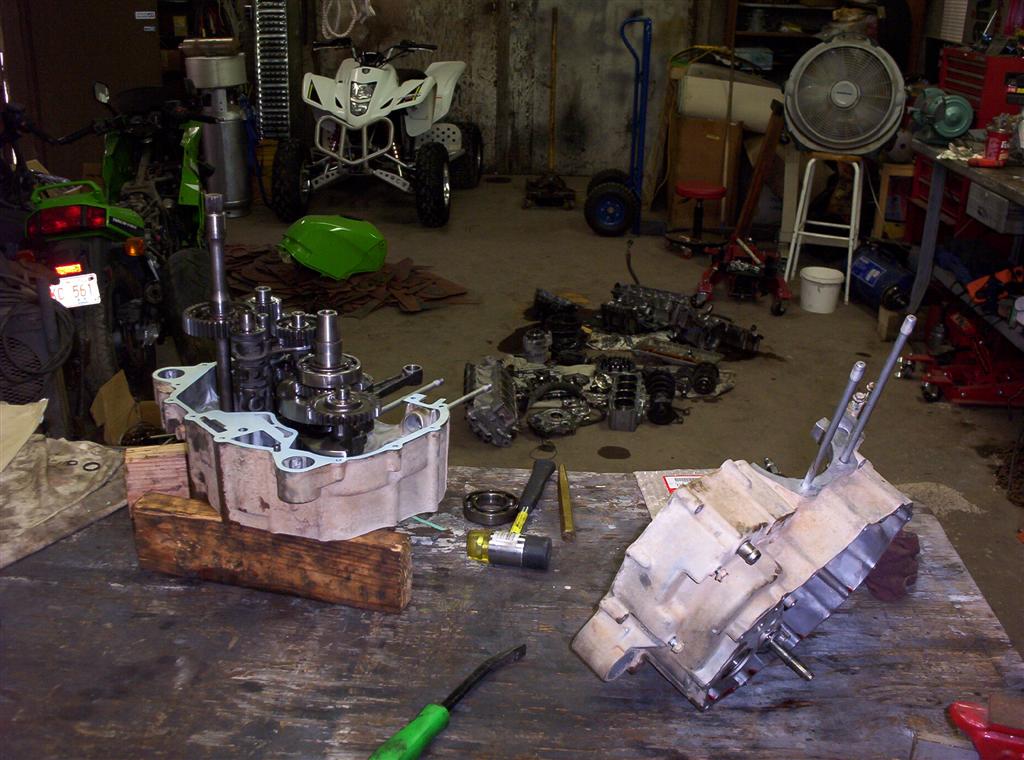
Assembling the Bottom End

Since the engine had been sunk in the mud, I really had to clean the cases, transmission, and bearings thoroughly. One thing that really helped on this project was my pneumatic gasket scraper seen setting on the left side of the table in the photo above. Using Permatex gasket remover also saves a lot of time.

After assembling the bottom end, the top end went together easily. When I first went to start the engine, the starter didn’t have to spin the crank a quarter turn before it fired right up. I ran it at a certain RPM to break in the cam, then it was ready to ride. It has the sweetest sound.

Unfortunately, I don’t have many photo’s of the build, but here’s some pics of the finished product…

Omni Recovery ATV Omni Recovery ATV

If you’re looking for a solid, workhorse ATV, this is one of the best.

Omni Recovery ATV Omni Recovery ATV

For more information and some general specs, as well as a list of all the accessories and equipment I have on my Foreman, see the Honda Foreman 475 Omni Recovery ATV page here.

« Previous PageNext Page »

Blog at WordPress.com.